

A number of years ago I was a novice caver, eager to explore. I was also happy to be led by other more experienced cavers. One particular day we were exploring an extensive cave system which none of us had been to before. It was a bright, warm and sunny day as we walked across the fields to find the cave entrance. We have a joke in the caving community that when it’s lovely and sunny outside we always head underground!
Tight squeezes and dark, wet holes

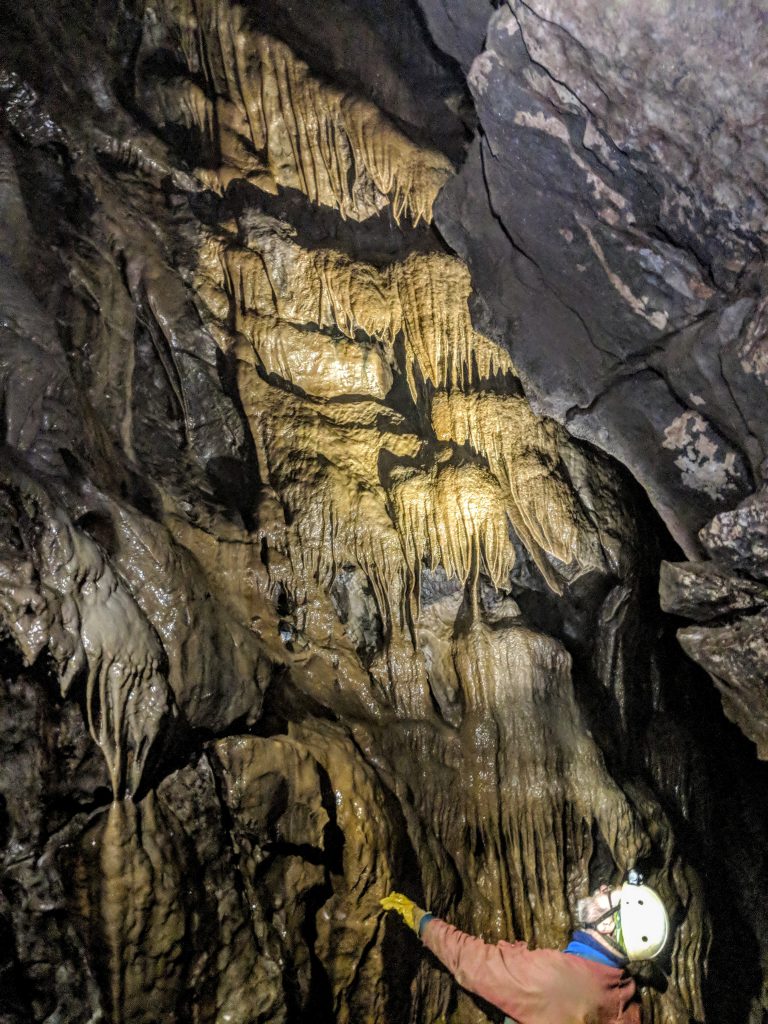
Now those of you who have done caving will know it’s not all tight squeezes and dark, wet holes. There are also enormous chambers which have amazing decorations such as stalactites, stalagmites and cave pearls. Then there’s the sparkle of calcite across the walls. This alone may have been enough to lure the seven dwarves deep underground in their quest for diamonds.
Lost in the deeper reaches
Anyway, we were happily crawling and climbing through this system, deeper and deeper into the further reaches. The hours passed by. Eventually we stopped to have a rest, drink and a snack. We also took a look at the underground map, or survey as it is known. After passing the survey around the group for several minutes we realised we were completely clueless as to where we actually were. The map bore little resemblance to anything we had passed by so far. It began to sink in that we were absolutely, undeniably lost.
We couldn’t remember the way back either so we decided the only thing to do was to keep going forwards. The hope was that our path would link up with a recognised part of the survey further on.
No turning back, no way forward
The route became more and more difficult and we became increasingly tired and dispirited. A kind of resignation settled over us. Strangely there were no feelings of panic, despite it being uncertain when, or if, we were going to get out. Eventually we were crawling down a long passage which finished in a narrow crack. We didn’t want to turn back but it looked like there was no way forwards. This is when my team members turned to me, the skinny one, and said “can you get through? If you can we might find a way on to another level and work out where we are.”
Don’t panic!
I really didn’t want to do this, the crack was very narrow, what if I got stuck half way through? What might be waiting for me on the other side? But I didn’t want to let down my buddies either and things were getting pretty desperate. I took off my helmet and started to squeeze through the tiny gap. When you’re squeezing through a small space the worst thing you can do is tense up. You’re much more likely to get stuck. But of course when you’re feeling panicky that’s the first thing you do. I had to make a supreme effort to overcome the waves of panic and ooze my way through.
At last I reached the other side and instead of the large drop I feared I entered a small chamber and a dead end. There was nothing for it but to go back and keep going.

Thriving in total darkness
We reached another large chamber and sat on the ground feeling utterly exhausted, dispirited and hopeless. Just sitting there and looking around I spotted a tiny mushroom near my feet. I tend to notice things like this, and wondered how it could thrive so deep underground. Imagine a tiny spore floating all the way down into the deep cave system. Finding purchase on very little organic matter and thriving in total darkness! I started telling my fellow cavers this but, oddly enough, they weren’t interested.
Well they weren’t until I exclaimed “Hey, I recognise it!” “I do, it’s the very same mushroom we saw on the way in, hours and hours ago. Don’t you remember?” Everyone shook their heads. But then another caver pointed to one of the many passages leading from the chamber. “Isn’t that the way we came in?”

Reaching daylight
And then we started to carefully make our way back. Stopping to recognise various landmarks along the way and, at last mercifully, we reached daylight. Only just! We had been underground for nearly nine hours and the daylight was fading as fast as our hopes had been.

Learning experience
Well, I learned a few important lessons that day! I learned that although we cave as a team we have individual responsibilities. Also, I realised the importance of supporting and encouraging each other when things get tough. Furthermore, I decided as a very minimum that I needed to learn more. How to read a survey and the importance of leaving markers or remembering landmarks. Also to keep looking backwards in an environment where one boulder looks much like another. It is incredibly easy to become disorientated, especially when there are many passages and levels leading off in different directions.
Respecting caves
Caves need to be respected as they are amongst the most hostile terrains on earth. Underground for hours at a time, cavers can face rising water levels, failure of head torches, tight squeezes and vast drops into darkness. Injuries and fatalities can be caused by drowning, exhaustion – particularly whilst attached to ropes, being hit by loose boulders, falling and hypothermia.
No backup
There is a total absence of light underground. If your headtorch fails and there’s no back up then chances are you may not find your way back out. I’ve heard some great stories, including some from experienced cavers who ought to know better. Stories about headtorches failing and having to navigate with a lighter and a few matches. Sadly there have also been a fair few fatalities in the past, mainly amongst children and young people who have gone into a cave for an impromptu exploration and their lights failed, they were unable to find a way back out and by the time they were discovered it was too late.
Tricky rescue
Rescuing injured people from caves can be very tricky, especially when there are tight squeezes to be negotiated. If someone has a suspected spine or neck injury carrying them on a spinal board can be a tortuous and lengthy process. We are very fortunate to have cave rescue organisations with highly trained volunteers willing to give up their time and use their skills to rescue fellow cavers when needed.
Many accidents occur because equipment isn’t being used properly, this is particularly important when using ladders or ropes to climb up and down pitches. On free climbs cavers tend to “spot” each other so that slips and falls are less likely and if they do occur tend to be less severe.
Personally, I have undertaken basic rescue training courses which have given me the skills to assist cavers who are struggling to climb ropes on long pitches, as exhaustion can be a very real problem particularly nearing the end of long trips underground. I have also learned self-rescue techniques which can be pretty handy if my fellow cavers don’t have the skills or equipment to help me out.
A big passion
Caving is a big passion of mine and I’m not trying to put people off, with proper attention and care it is a very safe and highly enjoyable sport. Most unpleasant scenarios are preventable with a bit of fore-planning and ensuring that you’re carrying and wearing the right kit.

MUST DOS:
Planning
Before going into any cave or mine system, look at surveys, plan a route, get some idea of the layout if you’re not already familiar with it. Remember it takes longer to come back up than it does to go down, so factor that into the length of the trip. One of the most common call outs for cave rescue is cavers not estimating how long they’re going to be underground for and obviously there is no phone signal underground either!
Call out person
Make sure you have a call out person on the surface and that they understand there is an expected time out and a call out time. If your call out doesn’t hear from you by the allocated time they should call 999 and ask for the police and then cave rescue. Give them as much information as possible, the name of the cave, grid reference, where the cavers vehicles are parked and the registration numbers of these.
Basic kit
As a basic kit always carry spare batteries plus a spare head torch worn around the neck so that if you lose your bag down a pitch you still have it on you. A watch to keep track of time is also a good idea and a personal first aid kit as well as food and drink are vital. Extra layers and a woolly hat are sensible precautions in case you do end up being underground for longer than intended.
Ropes
If using ropes, a spare rope should be kept handy for assisting cavers or in rescue situations. A knife sharp enough to cut through rope is also an important accessory, as is a whistle to alert fellow cavers – for instance near underground waterfalls it is impossible to hear voices so whistle signals become vital. Finally if a survey is available, bring a laminated copy which will stop it being obliterated by mud or water.
HYDROLOGY
Do your research and find out if the cave you’re going into is prone to flooding. If so always check the weather forecast before heading underground and look at what’s been happening over the proceeding days and weeks. For instance is the ground already saturated? In which case further heavy rains may cause significant run off. Are the surrounding stream/river levels high? Is the water clear or discoloured with debris in it? Is a sudden snow thaw likely to occur?
Quickly flooding
Many caves have active stream ways running into them and can flood very quickly. Making headway through flowing cold water can be very slow and difficult. A cubic metre of water weighs one tonne and fast flowing water doesn’t have to be above knee deep to sweep a person off balance. In constricted areas even small amounts of rising water levels can be dangerous. To ascertain to what extent a cave may flood to there will be signs such a mud, leaves and grass debris deposited on the walls and even the roof. It’s good to make yourself familiar with these indications as it can be a deciding factor as to whether you want to risk entering the cave at high water levels.
If you do find yourself trapped in a flooding cave can you navigate your way to higher ground? In the UK floods tend to be short lived, however hypothermia presents a very real risk. Meanwhile in other countries with monsoon climates you probably won’t succumb to hypothermia but caves can be flooded for months. This is what happened recently when the Thai football team became trapped in a flooded cave and the international rescue operation ended up being a race against time. Even if the water levels could be controlled by the pumping system they had installed the air quality inside the cave was dropping rapidly. This was a simply extraordinary rescue operation in which the divers managed to bring out every last one of these children alive and physically unharmed.
HANGING DEATH
There are areas in caves, and especially in mines which are notoriously unstable, where you are going to encounter loose rocks. Cavers have to be very mindful of where they place their hands and feet to avoid dislodging boulders either onto themselves or unwary cavers below. In some sections we adopt a policy of waiting for one caver to be safely through before following.

I have been in a situation where a loose boulder was accidentally dislodged from a height and gained momentum on a near vertical slope. It hit a descending caver squarely on his arm. It was a tricky exercise to help this person, who had a suspected fracture, and at one point involved lowering him down on ropes as he was unable to free climb with his injury. If a boulder or even small stones are accidentally dislodged from the top of a pitch it is the duty of the responsible caver to yell “below” and the caver underneath must avoid the natural instinct to look up, so making sure any impact is taken by the helmet instead.
BAD AIR
High levels of carbon dioxide can sometimes be a problem, particularly in mines, where natural ventilation isn’t always good. Cavers can become unusually fatigued and other signs can be constant yawning and developing a headache. If these symptoms are experienced it is best to find a way out as soon as possible.
WHEN THINGS GO WRONG
It’s very easy for panic to set in when things go wrong. This of course is the worst thing you can do. If you are lost or someone has been injured it is vital to consider a plan of action carefully and calmly. Also, conserve your energy as there may be a long wait for help to arrive. However as long as you have organised a call out, have food and drink and are able to keep warm you will at the very least have a great story to tell when you finally get back to the surface!
About the author:

Renuka Russell is a qualified Western Medical Herbalist with a particular interest in using the medicinal plants and trees found growing locally.
She runs workshops, walks and community events to enthuse and encourage people to learn about and respect their natural surroundings and how to identify plants and forage safely.
Renuka is the owner of Be Outdoors, based in The Peak District, which comprises a team of outdoor activity instructors and therapists enabling people to benefit from outdoor experiences for their physical and mental well-being and to enhance all areas of their lives.
You may also be interested in:
British Cave Rescue Association
