

Fruits of the Forest
Although the nights are drawing in now, there is a lot to look forward to in Autumn. The return to longer and cooler twilights is an excuse to light the wood burning stove. Freshly cut wood chippings gently steaming and the sharp tang of pine and woodsmoke in the cold air.
The beautiful sunsets which flood the valley and set the red and yellow leaves aglow. The dew caught up in heavy beads in the spiders’ webs and the crunch and swirl of leaves underfoot.
And of course, the abundance of fruits, berries and nuts in our hedgerows and woodlands, there for the picking and eating in so many versatile ways.
Rowan (Sorbus aucuparia)
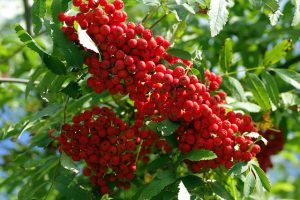 The rowan tree is sometimes referred to as mountain ash. It’s often found growing at high altitudes but it is not related to the ash, despite the leaves looking quite similar. In fact, it is a member of the rose (Rosaceae) family.
Its clusters of creamy white flowers are superseded by the bright red berries in the autumn months. These are very much loved by birds and were used in the past to lure songbirds onto the dinner plate, a custom now thankfully no longer practised.
Many people avoid the berries as they believe them to be poisonous. This is not true and a lovely rowan berry marmalade can be made from the fruit, as well as the more traditional jelly.
The bitterness and astringency of the berries makes them unpalatable to eat raw. Furthermore they contain parasorbic acid which can cause stomach upsets or even kidney damage if consumed in quantity.
However, cooking breaks down this acid into harmless sorbic acid and removes some of the bitterness as well. They do, however, retain some of their bitter properties which makes them a great digestive remedy and gallbladder stimulant.
Bletted
Ideally the berries should be bletted, this is a process whereby the fruit is allowed to ripen beyond its current ripened state. This leads to an increase in fruit sugars and beginning the process of breaking down the parasorbic acid and tannins. Those are what’s responsible for the astringency and bitterness.
The berries are best harvested after a sharp frost which starts off the bletting process and begins to break down the cell walls. Failing this, they can be popped in the freezer for a few days.
Rowan berries are reputed to boost the immune system and reduce bacterial infections and they contain high amounts of vitamin C and beta carotene. The syrup is a great remedy for sore throats and particularly recommended for singers and public speakers who use their vocal cords a lot.
To make the syrup:
- Chop the berries roughly and place in a saucepan.
- Add 2 litres of water, bring to the boil and then simmer for 15 minutes.
- Remove from the heat and mash the berries to release the juice and when cooled strain through a muslin bag.
- Return to the saucepan and add another litre water.
- Bring to the boil again and simmer a further 15 minutes, then strain again.
- For each litre of juice add 300 g of sugar.
- Heat and stir until the sugar dissolves and then boil for 5 minutes.
- Pour into sterilised bottles and leave to cool.
The syrup can be stored in the fridge and will keep for several months.
Elderberry (Sambucus nigra)
 It’s time to get out and start picking elderberries before the birds get them all!
These little berries are amazingly medicinal and have a potent antiviral action found to be effective against certain strains of flu, as well as being anti inflammatory and soothing for sore throats, sinusitis and nasal congestion.
There is some evidence to suggest the berries can help lower bad cholesterol levels too. Overall, they may provide a boost to the immune system and are a great tonic at this time of the year.
Every Autumn I make Elderberry Rob, (or syrup), to last me and my family through the long winter months.
The method is quite straightforward:
- Snip off the heads with as many ripe blackberries as possible and once you get home remove the berries carefully from the stalks. I find that using a fork to do this speeds up the process.
- Place the berries in a saucepan and bring to the boil with just enough water to cover them.
- Add some grated root ginger, a stick of cinnamon and a few dried cloves and simmer the mix for 30 minutes. Put on one side to cool and remove the cinnamon stick.
- Once cooled strain through a muslin bag or cloth. You can also use a sieve but you will be squishing the berries and it can get messy! Squeeze the bag gently to extract all the liquid.
- Return the mix to the saucepan and add sugar or, even better, a few tablespoons of local honey. I also like to add some brandy at this point which may preserve the syrup for longer, but strictly speaking this isn’t necessary.
- Heat gently until the honey or sugar is completely dissolved. The mix is now ready to be poured into bottles and labelled.
Store in the fridge where, unopened, it can last up to ten weeks. Take 10 mls, (2 tsps), morning and night. It tastes very nice just as it is. It can also be added to soft drinks or red wine and, if you haven’t added the brandy, even poured over ice cream for the kids to enjoy.
Guelder rose (Viburnum opulus)
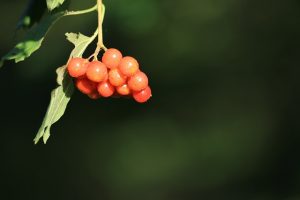 This beautiful shrub has pretty white flowers in the summer, maple shaped leaves and translucent, bright red berries in the autumn. The berries turn black on drying and have been used in the past for making ink.
Like many berries, they are mildly toxic when raw and can cause digestive upsets if consumed in any quantity, but they are great to use in jellies and jams and are a rich source of vitamin C.
However, be warned as the berries can leave a rather strange aftertaste when eaten and have a slightly unpleasant smell about them too!
This plant is also known as cramp bark and is great for relaxing smooth muscle found in the stomach and lungs, it may also be helpful for muscular spasms and migraine.
To make a medicinal tea:
- Carefully remove a small amount of the bark from the stems of the shrub,
- Cut into small pieces and place somewhere warm and dry.
Once the bark has dried completely it can be stored in an airtight jar and will keep for a year or more.
A decoction can be made by adding 2 teaspoonfuls of crushed bark to 250 ml of cold water and bringing to a boil in a saucepan, then simmer for 10-15 minutes and strain.
Blackthorn (Prunus spinosa)
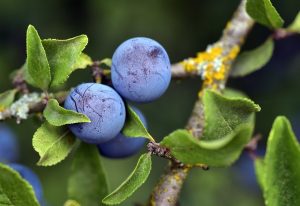 This shrub is a member of the rose family in common with plums, pears, apples and strawberries, indeed many of our most delicious fruits come from this family.
However, it is best known for the little dark fruits with the purple sheen that it produces, which just happen to go so well with gin. These are also known as sloe berries.
Making sloe gin isn’t slow at all! The process only takes about twenty minutes, the slow bit is waiting for the three months or so for it to be ready.
The good news is that if you start now it will be ready just in time for Christmas. It is best to wait for the first frost which can improve the flavour by starting off the process of breaking down the cell walls and making the fruit a little less bitter. Putting sloes in the freezer for a couple of days is just as effective.
The basic recipe I use is:
- 500 g sloes
- 250 g castor sugar
- 1 litre gin
- Cinnamon stick (optional)
- I half fill my one litre Kilner jars with the sloes,
- add the sugar and finally add the gin up to the top.
- Once sealed I gently shake them to dissolve the sugar.
- Continue to give the jars a gentle shake each day for about a week and then put in a dark place for about three months.
- After this time, strain the mixture through muslin cloth and decant into bottles.
Some say you should leave the bottles for up to a year in a cool, dark place before drinking, but I’m far too impatient and I’ve always found it very pleasing to my palate when left for a much shorter time than that.
English Oak (Quercus robur)
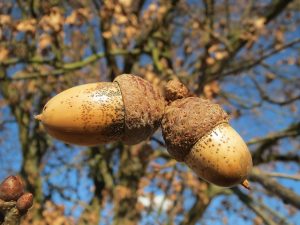 I love the quintessential Oak tree which can be found growing in hedgerows and woods but is often seen in solitary splendour in the middle of fields and at the edge of valleys.
The tree is firmly rooted in British culture and the Yule log, brought out from one year to the next for Yuletide celebration is traditionally fashioned from Oak.
The tree is reputed to live for a millennium or more and doesn’t start to produce acorns until it is around forty years of age.
Acorns are poisonous to horses and cattle but pigs can tolerate them in small amounts. They are not, however, toxic to humans and they used to be an important food source, especially during the winter months.
The leaves, bark and acorns from the tree also have the ability to tighten and tone the gut membrane and hence may be used medicinally in chronic gut conditions.
This is because the tree contains very high levels of tannins which explains why oak was also used for tanning, (softening and preserving), leather.
These properties also lend acorns a bitter taste and is perhaps why they are sometimes used as a coffee substitute where the bitterness is appreciated. They can also be ground into a flour and used in bread making.
Other benefits of acorns
Their ability to regulate blood sugar levels and they may also help lower bad cholesterol and are a good source of polyunsaturated fats. They are also packed with protein, B vitamins, vitamin A and contain all the essential amino acids.
However, be very careful not to overdo the consumption of acorns as the high tannin content may cause nausea and stomach cramps. Green acorns are unripe but if mature may be picked and left to ripen until they turn brown.
You must boil the acorns in water and repeat this process several times until the water stops turning brown. This removes some of the bitterness and decreases the likelihood of digestive upsets.
Hazelnut (Corylus avellana)
 If you’re lucky you can gather these nuts before they’re squirrelled away or munched shamelessly on the spot by those small furry creatures!
Like other nuts, hazelnuts contain high levels of vitamin E and produce one of the most highly unsaturated oils.
They also have significant amounts of beta carotene, folic acid and the minerals manganese, magnesium, phosphorus and iron and are a good source of dietary fibre and protein.
Hazelnut is monoecious, meaning that individual male and female flowers develop on the same tree. Male flowers are the showy yellow catkins whilst the red coloured female flowers are very tiny.
Wind carries the pollen to the female flowers during the winter months, which then remain dormant until the following summer when the fruit starts to develop.
The nuts develop in clusters and, once mature, fall out of the husks and onto the ground below. These are gathered and buried by squirrels who, being forgetful little creatures, don’t always remember where they put them, hence potential new trees are planted in situ and ready to grow.
Greeks and Romans
The Ancient Greeks used hazelnuts for treating coughs and baldness whilst the Romans fashioned torches from the branches for wedding ceremonies, believing that hazelnut ensures a long, happy and prosperous marriage.
Today hazelnuts are one of the most commonly cultivated and consumed nuts and there is evidence of cultivation and harvesting of them more than 5000 years ago. It’s a lovely oil to cook with if you like the strong flavour.
I use hazelnut oil in my massage practice too as it is very nourishing and has the ability to penetrate deeply into the skin’s layers. It also has astringing (drying) properties, making it useful for conditions such as acne or oily skin.
Sweet Chestnut (Castanea sativa)
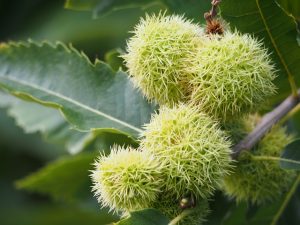 Sweet chestnuts come wrapped in spiky cases and look a bit like tiny hedgehogs.
They are best picked up from the ground soon after they have fallen and should still be firm to the touch, ones with little holes in them should be discarded as this is a sign of weevil infestation.
The chestnuts are high in carbohydrates, B vitamins and vitamin C.
The leaves and bark of the tree are highly medicinal and possess tannins which have astringent and anti bacterial properties.
They are beneficial for conditions such as diarrhoea, mouth ulcers, and promote external wound healing.
In addition, it has an important compound called hamamelose which acts as both a cough suppressant and expectorant making it useful for treating respiratory conditions such as bronchitis and dry coughs.
A tea made from the leaves can also soothe mild asthma symptoms and was formerly employed to alleviate whooping cough.
Preparing our native chestnuts to eat can be a bit laborious in comparison to the larger, shop bought ones, but they are delicious and definitely worth it.
The traditional and easiest way is to roast them. Carefully cut an X shape into the flat side of each nut, penetrating the shell but not cutting into the flesh underneath. You can put them under the grill, or even on a metal tray or shovel in the embers of a fire.
The chestnuts should be roasted until the shell splits open at the cut, or until you see steam or hear them hissing. Remove the shell once sufficiently cooled and enjoy!
Remember the golden rules of foraging:
- Only take what you need and know you will actually use
- Don’t pick from areas where the plant is scarce or you don’t have permission
- Be very, very careful to identify correctly- “if in doubt leave it out”.
- Be aware that just because it’s natural does not mean it’s safe and suitable for everyone.
- Do consult your GP or medical herbalist if you are taking other medications as adverse interactions can occur. If pregnant, or if you have a medical condition, be very cautious and seek medical advice if you have any doubts.
- Finally, if you haven’t tried something before, try only a little to start with in case you should have an allergic reaction.
About the author:

Renuka Russell is a qualified Western Medical Herbalist with a particular interest in using the medicinal plants and trees found growing locally.
She runs workshops, walks and community events to enthuse and encourage people to learn about and respect their natural surroundings and how to identify plants and forage safely.
Renuka is the owner of Be Outdoors, based in The Peak District, which comprises a team of outdoor activity instructors and therapists enabling people to benefit from outdoor experiences for their physical and mental well-being and to enhance all areas of their lives.

One thought on “Fruits of the Forest – by Renuka Russell”