

The Forager’s Month: January
The winter can appear to be a lean time of year for the forager. It certainly doesn’t have the abundance of fruits, berries and other floral edibles that are available in other seasons. And January is possibly the leanest of all the winter months!
Having said that, it’s not a complete whitewash either. There is still plenty of good foraging available. Whether it’s fungi, flora or seaweed you’re after, you should find plenty to keep you going.
Below is a guide to some of what’s available. There are others so keep an eye out for what you can find.
Black Mustard (Brassica nigra)

Although growing up to two metres, this plant will be considerably shorter at this time of year. The lower leaves have sharp serrated edges and the flowers are bright yellow. Unfortunately, Black Mustard is rare in the north and also prefers coastal areas. It also likes waste ground where it can be found in great quantities.
The leaves are very peppery but, when cooked, become quite bitter. It’s great for salads and pesto or, if cooked, in dumplings. Later on in the year, July and August, the seeds appear and they are edible too. The seeds have been used in cooking for thousands of years and are known for their spicy kick. They can be made into a mustard by crushing an mixing with vinegar. Alternatively, they can be sprinkled on bread dough before cooking.
Common Sorrel (Rumex acetosa)

This is found all across the UK in well established pasture and grasslands. It is around all year except in very harsh winters and high summer.
The leaves are generally long and arrow shaped and vary from 3 to 25cm long. However, when young, they are shorter and more rounded. There are always pointed ‘tails’ or ‘lobes’ at the base of the leaf. The leaves have a shiny appearance and are usually green but can develop red features.
Be aware that the poisonous Lords and Ladies, when young, have similar shaped leaves! Meadow Bindweed has similar leaves too but is easily distinguished as it does not, unlike sorrel, grow as a rosette.
Common sorrel has a sharp, citrus flavour a bit like apple peel. Consequently it can be used as a garnish, a salad leaf, in soups, stews or as an ingredient in cakes and sorbets. Younger leaves are best.
Medicinally, this plant has diuretic qualities and has been used in preventing scurvy and sinusitis.
Garlic Mustard aka Hedge Garlic aka Jack by the Hedge (Alliaria petiolate)

Found throughout most of the year in lowland areas, Garlic Mustard is easily identified. It has large kidney-shaped serrated-edged leaves, similar to large nettles. However, the leaves have a slight sheen and are a yellowy green colour. They also have a soft and slightly sticky feel to them.
Garlic Mustard is found by hedgerows, woodland, shady scrub and path edges. Its alternative names, ‘Hedge Garlic’ and ‘Jack by the Hedge’ are well deserved.
It has a mild garlicky taste and is good for inclusion in salads and dressings, dumplings and mashed potatoes.
Three-Cornered Leek (Allium triquetrum)
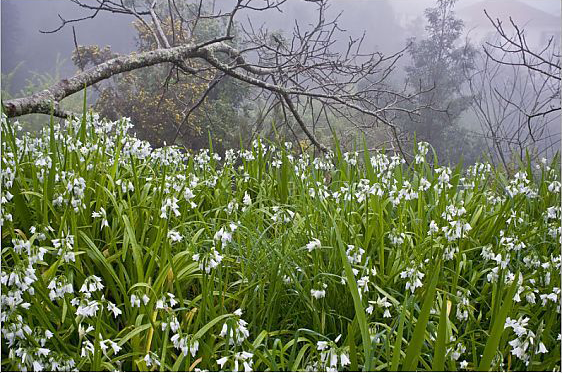
This is very common, particularly in southern and some western parts of England. It can be found elsewhere in coastal areas but not so much in Scotland. It is found in hedgerows, verges, woodland edges, field edges, waste ground and flower beds. Being an invasive species, it is an offence to plant it in the wild.
Three-Cornered Leek has more slender leaves than those of Wild Garlic. They have less of a garlicky flavour too but not as mild as the leek. The plant looks similar to a Bluebell but has white flowers with each petal having a green vein running down.
The whole plant is edible. Tasting a bit like spring onion, baby leeks or chives, it is suitable for use in salads. The leaves can be used in soups and stews. When more mature, the roots can be used as if onion or garlic.
Sea Beet (Beta vulgaris maritima)

If you’re close to the coast, this is definitely a ‘must forage’. It is considered by many to be superior in taste and texture to spinach. What’s more, it’s available all year round and is incredibly common, except in Scotland where it’s confined to the south-west. It grows on the upper shore and in grassland and rough areas along the coast.
The flavour is sweeter, richer but more mild than spinach. All leaves are good though new ones which form around April are best. When raw, the leaves are slightly bitter. They are soft and sweet after being steamed for fifteen minutes. This may blacken the leaves so, to prevent this, blanch before cooking. The roots are quite sweet, similar to sweet potato, or beetroot but without its colour.
Dandelion roots (Taraxacum spp)

Autumn and winter are the best times to uproot Dandelions, although it can be done at any time of year. The roots are best used as a coffee substitute although can be very bitter. Before grinding the roots into ‘coffee powder, scrub and slice them. Then dry and bake for about 25 minutes. Once prepared, use as instant coffee – with or without milk as per taste.
Velvet Shank (Flammulina velutipes)
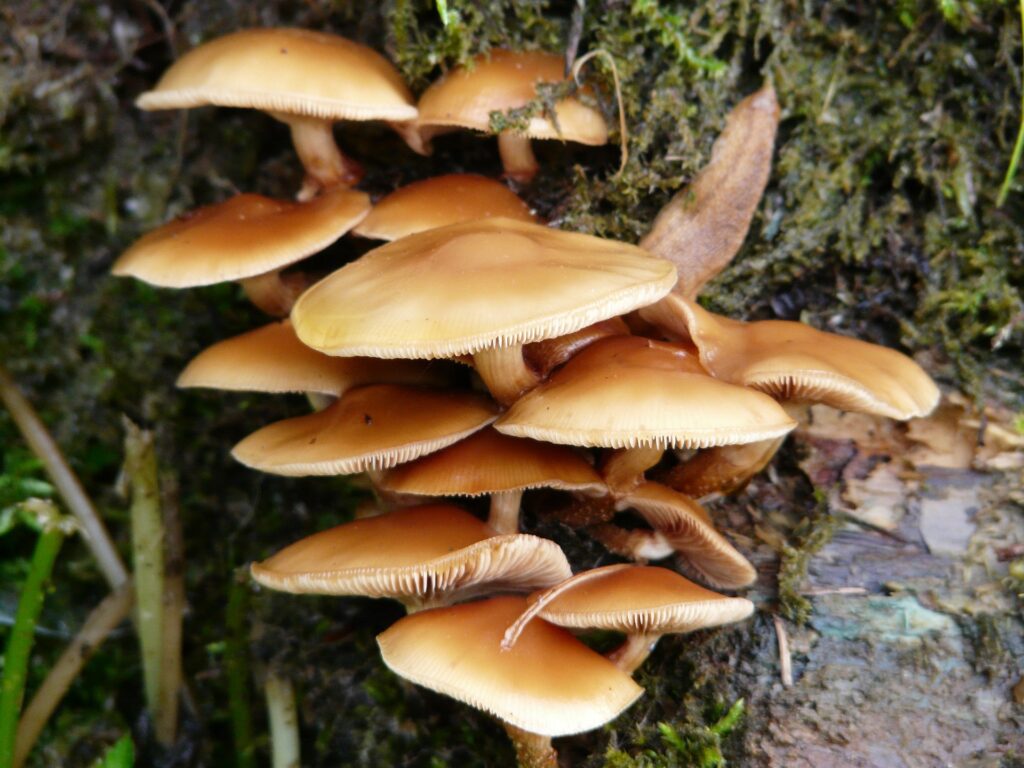
This is probably the best of the few winter mushrooms and is very common. They appear in large, dense groupings on rotting deciduous tree stumps, especially elm and ash.
It has a mild, pleasant flavour but the skin should be removed before cooking. Very suitable for frying or using as a thickening agent.
The Velvet Shank is easily identifiable. Mature specimens have white spores and black velvety stems
Wood Ear aka Jew’s Ear aka Jelly Ear (Auricularia auricularia-judae)

Although common all year round, Wood Ear is most abundant in the winter months – especially January.
This fungus can look remarkably like an ear made out of jelly. The favoured habitat is elder, both dead and alive. It is therefore easily recognisable. They are brown and have a shiny inner. The outside is paler.
Wood Ear doesn’t have a strong taste but is ideal for using as a stock when dried and ground to a powder. It is also very suitable for using in Asian style dishes.
Oak Moss (Evernia prunastri)

This is a very common lichen which can be found all year round. Its name derives from it growing, but not exclusively, on Oak. However it is not a moss! It is easily identified, being branched with flat lobes and having a paler green underside.
Oak Moss has traditionally been used in perfumes which gives an idea of its aroma. It should be dried then chopped or powdered like a herb and then best when mixed when frying food.
Winter Laver (Porphyra linearis)

This seaweed appears in December and lasts until March. It grows high up on the shore and often even above the high water mark. The best way to gather it is by sliding a fork under the fronds and then twisting. It should be cut, not pulled, up to two thirds of the growing sheets. Make sure that plenty is left connected to the rock and do not clear a whole rock or area.
Winter Laver needs to be cooked for five hours (much less time than other Lavers). Laver has no great flavour if eaten raw. However, once processed, it adds a rich, savoury quality to anything it is added to.
It is possibly best known in the UK, especially Wales, as a main ingredient for Laverbread. For this it is mixed with oatmeal and fried as patties. It can also be dried, toasted and crumbled as a seasoning for rice, salads and stir-fries and in stock powders. Furthermore, it’s great for enriching soups, and stews etc.
Remember the golden rules of foraging:
- Only take what you need and know you will actually use.
- Don’t pick from areas where the plant is scarce or you don’t have permission.
- Be very, very careful to identify correctly- “if in doubt leave it out”.
- Be aware that just because it’s natural does not mean it’s safe and suitable for everyone.
- Do consult your GP or medical herbalist if you are taking other medications as adverse interactions can occur. If pregnant, or if you have a medical condition, be very cautious and seek medical advice if you have any doubts.
- You must gain permission from the landowner before uprooting any plant.
You may also be interested in:
First Aid in the Wilds – by Renuka Russell
Healing Remedies & the Survival Medicine Cabinet – by Susan Bree
