

Indigenous Australian Glue and How to Make It – by Tom Foley
Glue. It is one of the most fundamental crafting materials. Used by humanity for thousands of years. Made by every culture from many materials and used in many different contexts. From hafting spear points to sealing containers and even as a first aid device to seal wounds. It is not hard to see why glue manufacture is a fundamental skill for living off the land.
Here in Australia the Indigenous people predominantly used the resin from a number of acacias and grasses. But the most common resin used along the Eastern and South-Western coast of Australia was the resin from the Xanthorrhoea or Grass Tree. Grass Tree resin was used for a variety of purposes by the First People of our nation. The most common uses include implementation as knife and woomera handles, tool hafting, container sealing and even as an ingredient in natural paint. Botanist Joseph H. Maiden notes:
“Grass tree resin is used in the making of their hatchets, hammers & in fixing the glass to their spears. Often times a meat cutter or native knife, made by fixing to a short hard piece of wood with the gum of the Xanthorrhoea , fragments of quartz”
J H Maiden, Australian Botanist.
While very strong and useful, resin glue is not as strong as most commercial glue. In most cases in the archaeological and anthropological records of Australia it is combined with other materials when hafting tools. Such materials include plant fibre (Stringy Bark, Sea Hibiscus, Lomandra and Jibung bark) and kangaroo and wallaby tail sinew to provide added strength.
Identification
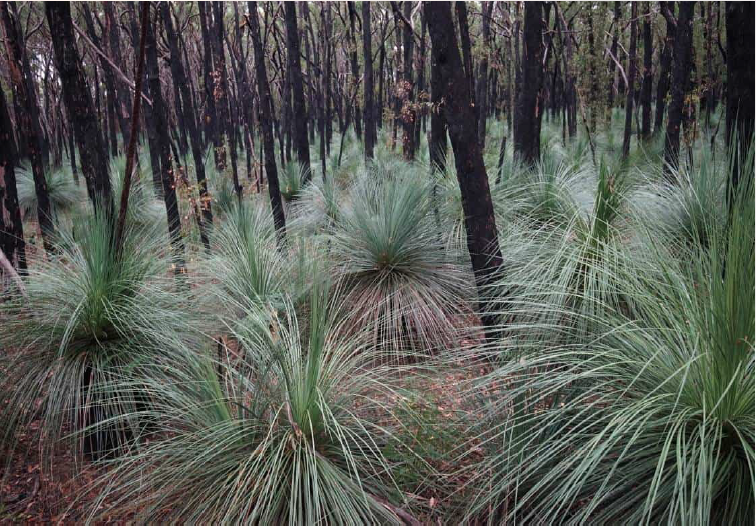
The family Xanthorrhoeaceae is found all around Australia. However it’s more in abundance along the East and West coast. All species of Xanthorrhoea have been given the common name of “Grass Trees”. Resin can be extracted from all species. Grass Tree gets its name from its appearance. It is characterised by a short, thick, black trunk topped with blade like leaves. Consequently it resembles a tree with a grass top.
The white base of the Grass Tree leaf is full of starch and is edible raw, roasted or boiled. The Grass Tree often has a large stalk tipped with a green seed head that grows from the centre of the leaves. This stalk is incredibly good for friction fire. It is best harvested around March-April when the stalk has died and the seed head has gone brown or black and released its seeds.
Collection
There are two main methods of Grass Tree resin collection. The first is simply picking globs of resin. These are found sitting on the outside of the trunk after a bushfire has gone through the region.

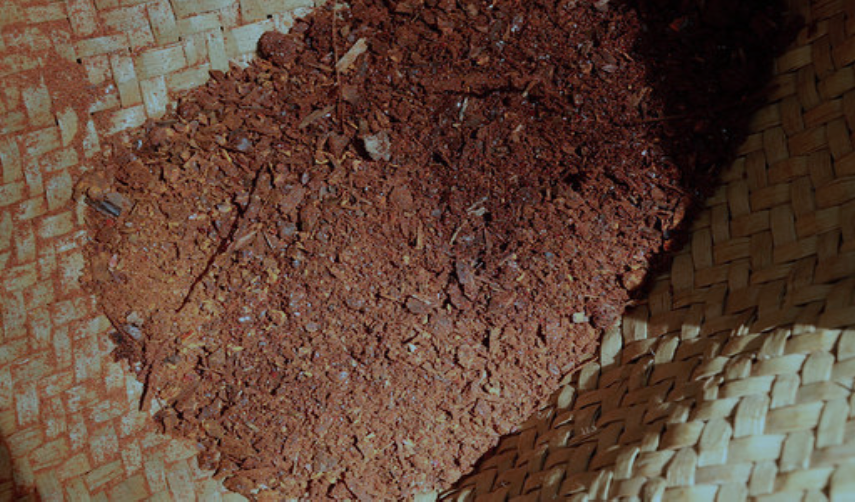
However, finding such deposits can be a rare occurrence which brings us to our second collection method. This involves taking a chopping tool and removing the outer black layer from the trunk of the grass tree. Ensure you stop when you reach the deep orange or red layer. The brighter orange the layer, the better the quality of resin. Then position a basket or piece of cloth below the area where you have removed the outer portion. Take a stone or metal saw and gently saw into the orange layer, collecting the fine dust. Be sure to take care and stop sawing before you reach the inner white heart of the Grass Tree. If you don’t, this will damage the plant.
Mixture
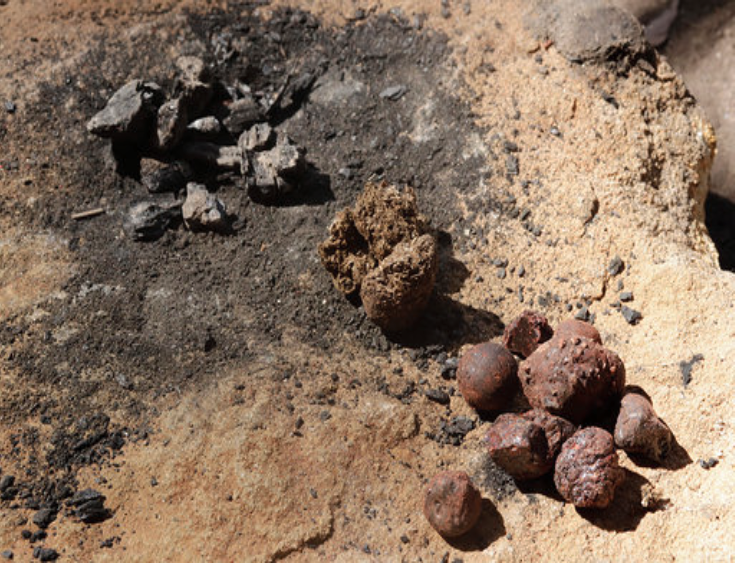
This resin is best suited for the hafting of stone hatchets, attaching hooks onto fishing line, woomera (spear thrower) pegs and other tools which must remain firmly in place. It also works for the sealing of rigid baskets and repair of canoes. To create this mixture, a hardening and a binding agent are used. For the hardening agent a variety of materials can be used. Those most commonly used in Australia are finely ground charcoal, sandstone dust or ochre dust. Similarly, a variety of binding agents were used by the Indigenous peoples to help bind the resin together. The dry scat of herbivores (Kangaroo & Wallaby) or the fur of a short haired animal such as the possum was the most common binding in Australia.
Step 1:
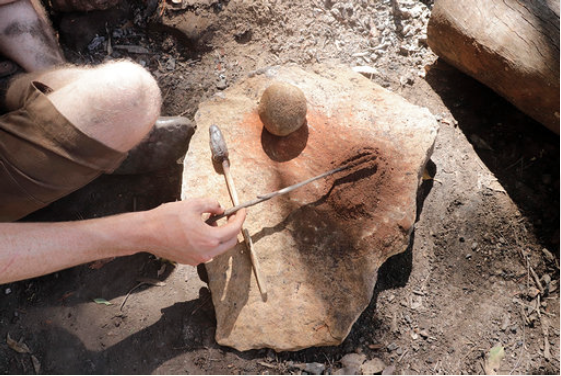
With your gathered Grass Tree resin, be it in globules or a powder form, place it upon a flat piece of stone or in a mortar and pestle. Then take a fist sized hammerstone and gently grind the resin until you have an even light powder. Again, using your hammerstone, take your hardening agent and grind this into a fine powder.

Step 2:
Take the resin and mix it with the hardening and binding agents. For this mixture the ratio should be roughly ¾ resin and ¼ hardening and binding agent. However, the ratio is largely dictated by personal preference. Experiment and find the best mixture for your needs.
Step 3:
Start a small fire and allow it to burn down to hot coals. Using a small diameter stick, gently roll this through your mixture. The stick should pick up a thin layer of powder. If it does not, simply moisten the surface of the stick and it will accumulate a thin layer. Then take the stick and rotate it over the hot coals until the resin has melted evenly. At this stage simply roll this through the mixture again. The hot sticky first layer will pick up another layer of dust. Then rotate it over the fire until this layer of resin has sufficiently melted. Caution: Hot resin can give you a very painful burn. Handle with care.

Step 4:
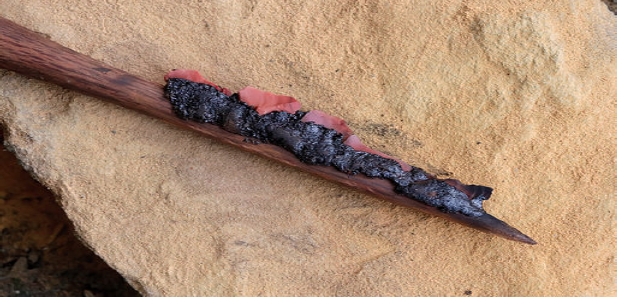
Repeat Step 3 until all the resin mixture has melted onto the stick. At this point you should have a large glob of resin on the end of the stick.
Step 5:
Now hold the stick away from the fire and rotate it so the resin mixture does not drip. Wait until the resin has reached a point where it is no longer at liquid consistency but is still warm and malleable.
Spit on, or wet, your hand so the resin mixture will not stick to your skin. Press the resin into the desired shape for storage. I personally like to press it into a ball on the end of the stick. Then allow it to cool until hard. Now you have a portable Indigenous glue stick that you can stow in your pack!
“The strength of this gum is extraordinary, for I have seen a Native use his Kadjo (hatchet) to cut large limbs off gum trees without at all loosening the stone.”
Philip Chauncy, Colonist.

Conclusion
Now you have the skills and knowledge to get out in the bush and make one of the most essential pieces of the Indigenous toolkit. This is used for gluing almost everything; the only limit is your imagination. With this mastic the Indigenous hunters craft their most quintessential weapon system. This is the woomera (spear thrower) and spear. It has been used to hunt everything from Procoptodon goliah (extinct megafauna species of kangaroo) to fish.
Almost every aspect of the Aboriginal toolkit had resin glue used in its manufacture: fish spears, stone axes, knives, adzes etc. The production of glue is an ancient human skill that has shaped our technology from the dawn of man. It is essential to those who intend to live off the land or those who simply wish to be prepared if things ever get a little dicey! Now go make your glue, haft some spearheads and get some mega fauna. I’ll see you guys out on the trail….
References
Maiden J.H 1889 The useful native plants of Australia Trubner, London. — 1890 On grass tree gum. Proceedings of the Lineanean Society of New South Wales. Vol.15, no.3, pp. 429-44
Chauncy, P. 1878. Notes and Anecdotes of the Aborigines of Australia. Appendix A in R.B Smyth The Aborigines of Victoria Vol. 1. John Ferres, Victorian Government Printer, Melbourne.
Michael Westaway-Jon Olley-Rainer Grun – https://theconversation.com/aboriginal-australians-co-existed-with-the-megafauna-for-at-least-17-000-years-70589
Smyth, R. Brough 1878. The Aborigines of Victoria. 2 volumes. John Ferres, Victorian Government Printer, Melbourne.
Photography by Kevin Newton of Australian Survival Instructors
About the Author:

Tom Foley is a young, enthusiastic Earth Skills instructor and practitioner, teaching at Australian Survival Instructors school since 2017. He specialises in indigenous skills and Experimental Archaeology. Tom’s mission is to learn dying skills and preserve the ancient ways of indigenous peoples from around the world. Passing them on to the next generation is an important part of this.
Tom is currently a Bachelor of Archaeology student, focusing on skills that have proved fundamental in the evolution and construction of humanity as we know it. This includes running, flintknapping hunting, friction fire, tanning and much more. He has travelled to Israel, the UK and Rarotonga to learn methods of living off the land and Experimental Archaeology. Despite this, Tom has only just begun his journey in preserving the first skills of humanity. He is now planning his next trip to live with the Hadza Bushmen of Tanzania.
With extensive experience in the production and recreation of artefacts, Tom has produced working replicas of stone age tools spanning from his home in Australia all the way to the frigid shores of the Arctic.
You may also be interested in:
Gunyah: The Australian Shelter by Kev Newton
