

As I sit here writing, cabin fever is becoming a very serious threat to my mental wellbeing. But lockdown, which is in place in many countries across the world, massively curtails our outdoor activities. I am yearning to get out into the hills and mountains. One of the numerous activities I was planning for the summer was to go bothying. Staying in a bothy is a great way of getting out into the wilds without the need to sleep in a tent.
Bothies are located in some of the most dramatic and beautiful landscapes of Great Britain. They therefore provide shelter for the outdoor adventurer in some ideal spots. Many mountaineers, hillwalkers, canoeists and general lovers of the countryside have made a bothy their home for a night. Some people may only stay for one night in a bothy. Others may travel from one to another, staying at a different bothy each night. A mix of camping and bothying might suit some better. However this all depends on individual requirements including time available.
Living in Scotland, I am lucky to have some of the most incredible and iconic landscapes nearby. Being close to the border I can immerse myself in breathtaking scenery without having to travel far. The Southern Uplands and the wonderful Northumberland National Park are only minutes away. Within a couple of hours drive are the dramatic Lake District and the Highlands. With a little more time I can find myself in the remotest parts that Great Britain has to offer. Without booking I can easily spend the night in a bothy.
What is a bothy?
Bothies are NOT holiday cottages. Typically they are small buildings previously used by estate workers. They have minimal furnishings, sometimes a fireplace or stove and a sleeping platform. Otherwise, nothing is provided for users! Users must carry in their own fuel, sleeping bags and food etc. They must also make their own provision for drinking water. Users should take their rubbish away with them. There is no rubbish collection at bothies! Some bothies have toilets but most don’t. There is usually a spade provided so that people can bury human waste.

Bothies are refuges for people out in remote places and suit the needs of those who travel in ones and twos. They are not suitable for groups*, whose use is therefore discouraged. Users of Mountain Bothies Association bothies are asked to comply with a Bothy Code. This is based on respect for the bothy, its surroundings, and other users. Users are also asked to observe any restrictions on its use requested by its owners.
* Note: The Border Bothies Association requires booking of its bothies so is suitable for groups.
Bad reputation for bushcrafters!
Neil Stewart, Publicity Coordinatior of the MBA informed me that a bothy had to be given back to the owner because of misuse. “One of the main things mentioned by the owner was folk cutting live wood for the fire.” He also stated that “one of our Maintenance Organisers found… a contraption for drying clothes… made of… live wood inside the bothy!” It appears that some people seem to think that this is practising “bushcraft”.
As bushcrafters we are very aware of leaving no trace and the sustainable use of the environment. Other people could well be using ‘bushcraft’ as an excuse for justifying their negligent behaviour. This gives genuine bushcrafters a bad name! The cutting and burning of live wood is absolutely forbidden in and around bothies.
Location of bothies
The map of MBA bothies, below, gives a really good overview of the location of bothies. However there are smaller bothy associations such as the Border Bothies Association too. Bothies are found in the Highlands and Islands, Southern Uplands, Northumberland, Cumbria and Wales in remote and usually upland areas.

Border Bothies Association
The Border Bothies Association currently maintains four bothies in the Tweed Valley. Three of these are within walking distance of each other and all within cycling distance. All now have Calor Gas cooking facilities, open fires and various forms of lighting. One boasts a running water system with hot baths available! All are very special places where folk can relax and enjoy the beauty and serenity of the Border countryside.

I used to take Scouts to Auchope Bothy, a former shepherd’s house, in a remote part of the Cheviot Hills. Access was possible by vehicle but it was rough going and well off metalled roads. It provided a great base for hillwalking and navigation training. The scouts would usually camp outside in summer. However it was incredibly useful having the use of the building if group catering or other activities best conducted indoors were required. In winter the scouts would sleep inside.
Sitting in front of a roaring open fire was a great way to finish off the day after the youngsters had settled down for the evening. Another benefit to staying in a BBA bothy is that you can book for multiple days/nights. It’s cost effective too as payment is by reasonable donation.
An Olde Worlde experience
Part of the experience for youngsters was staying somewhere away from the luxury of their accepted modern conveniences. Running water was available but had to be hand pumped. Often it was just as easy to collect water from the nearby burn (stream) with a bucket. Lighting was by means of gas lanterns and this was only in the kitchen and ‘dining’ rooms. In contrast to our modern lives this gave an ‘Olde Worlde’ feel to life. It was how many people used to live.
Unfortunately a recent change in ownership means that Auchope is no longer used by the BBA. It was a fantastic place to stay at and I deeply regret its closure.
The Mountain Bothies Association
Founded in 1965, the Mountain Bothies Association exists to maintain remote buildings for which the owner has little or no use. Furthermore they remain important to walkers and others who make use of the shelter provided. The MBA is not an accommodation provider. It is a bothy maintenance organisation. Only two of the bothies (Over Phawhope in the Scottish Borders and Glenpean in the Western Highlands) are actually owned by the MBA. All other buildings are maintained with the agreement and encouragement of the owners.

The Association does not receive any public subsidy. All maintenance work is financed from the MBA’s own resources. This is mainly through membership subscriptions but supplemented by generous donations. The BBA is run likewise but on a much smaller scale.
The Association is responsible for the maintenance of 105 bothies and two emergency mountain shelters (86 in Scotland, 12 in England and 9 in Wales). These shelters are unlocked and are available for anyone to use free of charge. All maintenance activities are carried out by volunteers and new members who want to support the Association in this work are welcomed.
Work of the MBA
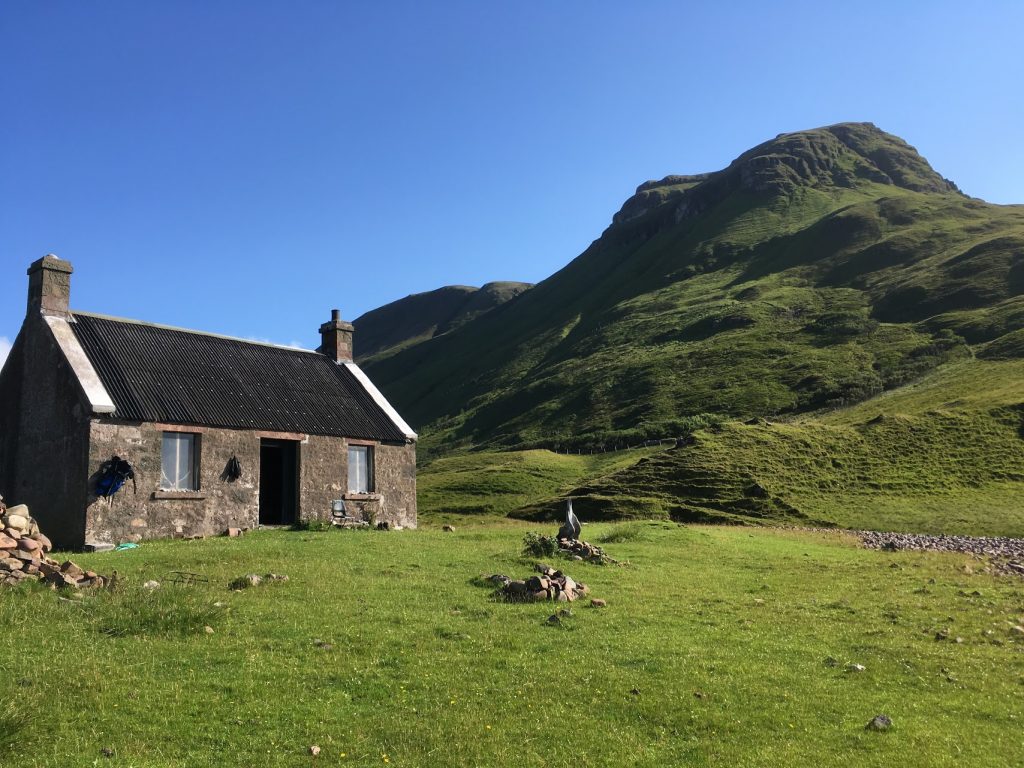
The MBA takes buildings that are sometimes ruins and turns them into wind and waterproof shelters. Subsequently these are maintained for use by those who use the wild and lonely areas of the country. Most of the work is undertaken by the MBA members who are all unpaid volunteers. The charity is run by a board of Trustees and these are also unpaid volunteers.
In 2018 the MBA spent around £108,000 on maintenance activities. Significant maintenance work was undertaken at over 100 bothies in their care.
Without the co-operation and support of the owners of the buildings, there would be no MBA. This would probably result in very few bothies. There has hardly been a renovation project that has not benefited from the practical support of an owner and their staff. Providing transport for materials and sometimes even paying for those materials for work parties are examples.
Usage of bothies is increasing as more and more people head for the outdoors as an antidote to a hectic working life. It’s hardly a surprise. They are part of the adventure of staying out in the great outdoors.
For further information:
Mountain Bothy Association
Visit the MBA website.
Use the MBA’s contact form to contact the Association.
Border Bothies Association
Anyone interested in helping with the work of the Association or in using the bothies for groups should contact:
David Dixon (Secretary), 8 Oswald Terrace, Prestonpans, East Lothian EH32 9EG
Tel: 01875 812985
You may also be interested in:
Islandeering: Five British Islands To Go Wild On – by Lisa Drewe
