

We’re probably all very familiar with how to use the stars to navigate. Identifying Polaris, using The Plough (or Big Dipper) in the Northern Hemisphere to find North. Using the Southern Cross in the Southern Hemisphere to find South. Although these are fairly easy to recognise, it’s always good to have other methods to use. In both hemispheres, we can use Orion to determine direction. The drawback is that Orion is only visible from Autumn to early Spring.

Orion is probably the most identifiable of all constellations and this makes it easy to find. This probably explains why it is so prevalent in the folklore of so many cultures. Orion is known as Uru An-Na in Sumerian mythology and means ‘the light of Heaven’. This refers to Gilgamesh who is fighting the bull Gud An-Na (‘bull of heaven’). We tend to refer to the bull as Taurus.
There are numerous variations in the stories. We, in the English speaking world, generally think of Orion as the hunter. Alongside his dogs, Canis Major and Canis Minor in pursuit of Lepus the hare, he faces Taurus.
Getting back on track, Orion can be used as an aid to navigation. However, we need to be careful. Orion rises almost exactly one degree off due east and sets almost exactly one degree off due west. To be more accurate, Mintaka, the furthest right star on Orion’s Belt, rises and sets at those points.

Mintaka is very easy to identify when the whole, or most, of Orion is visible. Unfortunately, when Mintaka first rises, it may be less obvious. For that reason it is essential to look for Orion’s Bow as this will appear first. Fortunately this is easy to recognise due to its shape. Having said that, the stars forming this curve are not always bright. Bellatrix and Betelgeuse, which are bright, will also appear before Mintaka does. These are therefore good identification points. Another issue is that when Orion first appears over the horizon, earlier in the evening, the sky may not be especially dark. Taurus, with its bright star Aldebaran, is worth looking out for as this appears just before Orion.
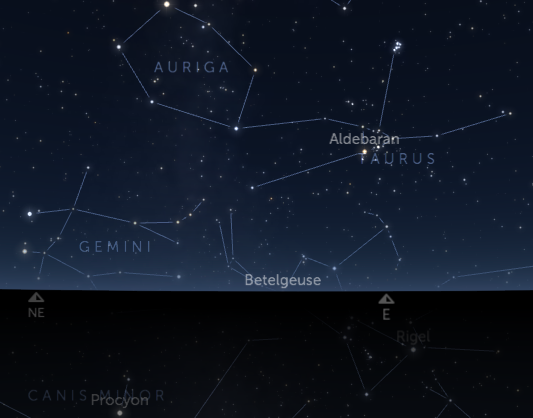
The actual time of year makes a big difference too. Orion may not be visible at all when Mintaka rises. It may not be visible at all when it is about to set. Orion will be there but at the time of rising or setting daylight prevails. Familiarise yourself by using sites such as staratlas in conjunction with the night sky.
On the other hand, the whole of Orion, depending on cloud cover and time of year, will be visible prior to setting. Consequently it should be easy to identify west by following Mintaka.
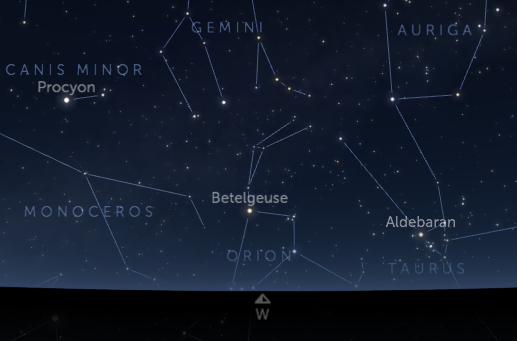
There is also the problem of being around at the right time to view the constellation at its best moment for finding east or west! Much of the time I have viewed Orion is when it’s already beyond the stage of rising or considerably before setting. At such times it is possible to get a rough idea of direction though. Note that the emphasis here is on ‘rough’, not accurate.


Orion’s sword always points vaguely south. When an imaginary line is drawn when it the sword is vertical, it intersects with the horizon at a point very close to due south, but at times when the sword is closer to the horizon, ie. closer to east or west, then the point of intersection will also mover closer to east or west respectively.
There are more accurate ways of using specific stars within Orion to help us to find direction that are relevant to different latitudes. These will be covered in a later article.
