

Fridtjof Nansen’s incredible crossing of Greenland took place 130 years ago. The Royal Scottish Geographical Society’s blog post by Jo Woolf has been adapted and condensed by Nick Allen.
Fridtjof Nansen: The First Crossing of Greenland
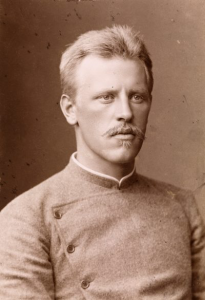 A few other explorers had previously attempted similar crossings of Greenland but without success. The Finnish explorer, Adolf Erik Nordenskiöld, had tried twice before. American naval officer, Robert Peary, had pushed inland for 100 miles but was forced to turn back. Nansen said that people thought he must be “either mad or tired of my life” (Scottish Geographical Magazine, 1889) to attempt it.
In 1882, Fridtjof Nansen glimpsed the coast of Greenland for the first time. At that time he was a 20 year old zoology student on board a whaling vessel and engaged in marine research.
Seeing the unexplored coastline, he pleaded with the captain to be allowed to go ashore but was refused. However, Nansen’s dreams combined with his skills and experience enabled him to lead a successful expedition six years later.
Planning the expedition
“My opinion was that if you fitted out an expedition in a proper way it was not at all an impossibility to cross Greenland, and the very men for such an expedition would be Norwegian ‘ski-runners’.” (SGM, 1889)
All previous attempts to cross Greenland had started from the west and headed east. Nansen strongly believed this was a reason for their failures. “If we started from the west coast … I was quite sure we should not be able to cross, for then we should leave ‘the flesh-pots of Egypt’ behind us, and in front of us would be the ice-desert and the east coast…” (SGM, 1889)
Flesh-pots
These ‘flesh-pots of Egypt’ referred to the scattered settlements up and down the west coast. Shelter and hospitality for hopeful explorers about to make their way across the interior could be found here.
Nansen would start from the uninhabited east coast and head west. They would head towards civilisation and the incentive of reaching such ‘flesh-pots’ would drive them forward. Nansen contrasted the choice as “Death or the west coast of Greenland.”
Expert advice
Nansen’s university studies were drawing to a close in the spring of 1888 and he looked toward his opportunity. A great deal of planning, negotiating and decision-making were crammed into the last few months before his departure. Nansen consulted with Nordenskiöld and Gustav Holm, another veteran explorer, seeking advice regarding supplies and equipment.
The team
He knew he would need a strong and dependable team and advertised that he was looking for recruits. He then waited to see who would apply.
One of the first was Oluf Christian Dietrichson, a Norwegian military officer with considerable experience of long-distance skiing. Another was Otto Sverdrup. He had grown up in northern Norway and was an experienced skiier and seaman. Sverdrup also recommended Kristian Kristiansen, a neighbouring farmer and a tough skiier.
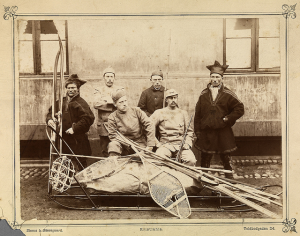 Nansen needed two more men. Nordenskiöld had assured him that men from Lapland would be suitable. They were adept at finding their way in a featureless landscape, an essential quality for polar expeditions. Nansen immediately telegraphed a contact and asked him to find two suitable candidates.
He met Samuel Balto and Ole Ravna in Christiania (now Oslo) for the first time only three weeks before departure.
Mistaken identity?
Nansen had specified that he wanted young, unmarried men from nomadic families who lived in the mountains. He was shocked to discover that Ravna was 46 and had a wife and five children. As for 27-year-old Balto, he came from the more settled families who lived in the river valleys. Neither of them had ever left their homeland before and were already feeling homesick. It was too late to send them back!
Skills and attitude
Despite all the anxieties and uncertainties of what might lie ahead, Nansen had numerous skills in his favour. He was a superb athlete and had honed his fitness since childhood in the forests around his home. Nansen was also a passionate cross-country skiier. He would take himself off for weeks at a time, camping alone and living off fish and game. His mental attitude to survive Greenland’s harsh conditions was unquestionable. Whether or not he was a leader of men remained to be seen.
Adaptations for success
In the late 1800s there wasn’t really any specialist equipment available for polar conditions. Nansen investigated everything analytically. He analysed the team’s need for skis, boots, reindeer-skin sleeping bags, tent, cooking stoves and other equipment. These were then specially designed or adapted from the most efficient versions available.
He was a pioneer of the layering system of clothing, preferring light woollen garments in place of more cumbersome furs. Another important consideration was food. As well as the ‘pemmican’ of dried meat pressed into fat, he took supplies of dried bread and biscuit, sugar, pea soup, tea and coffee. (the promise of coffee helped persuade Balto and Ravna to keep going at difficult times.)
Pulling the sledges
Although Nansen had considered taking a team of dogs to pull the sledges, he dismissed the idea due to his inexperience in dog-driving. He considered reindeer instead but realised that they needed vegetation to graze on. There would be very little of that where he was going. The men would have to pull the sledges themselves!
Rather than using one large sledge, Nansen chose to take five smaller ones instead. This would allow two men to pull the lead one. The traditional Norwegian sledge or ‘skikjaelke’, built of ash for lightness and strength, would be used. However, he adapted this by attaching thin steel plates to the runners of elm and maple. Instead of using nails or pegs, the pieces were lashed together with leather for flexibility.
Go with the floe
Four days after receiving his postgraduate qualification, the new Dr Nansen set sail for Greenland.
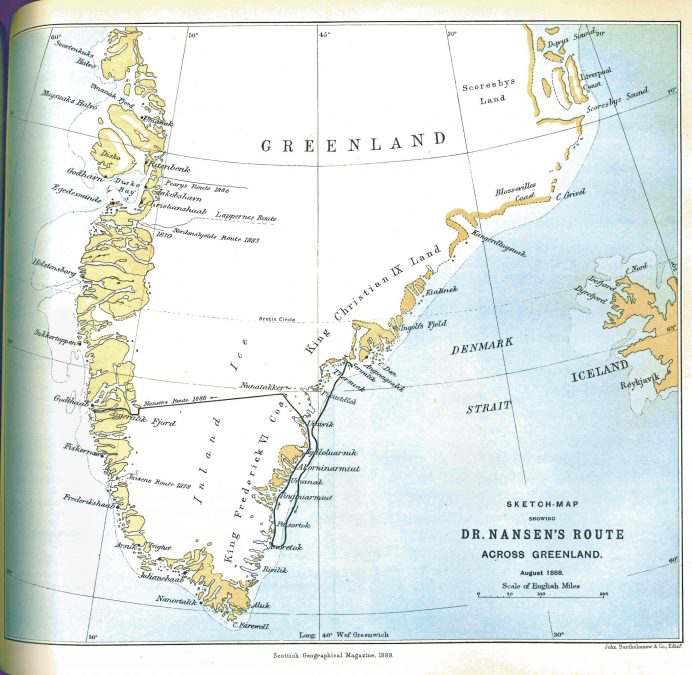
A Norwegian sealer deposited the group into the ice-choked waters of Sermilik fjord where their two small boats nosed their way between icebergs in search of land. They pitched camp on an ice floe that evening but strong currents swept them a long way south for nearly two weeks. On 29th July, they eventually landed on a rocky island called Kekertarsuak, but this was too close to the tip of Greenland to attempt a plausible crossing. They had to row northwards again.
Gathering strength
On 10th August, exhausted, they finally made landfall at Umivik where they rested for a few days to gather their strength. They shot birds for food to conserve their rations. Finally, on 15th August, they left their boats upturned on the shore and prepared the sledges and donned their skis. The crossing of Greenland had begun. It wasn’t always easy!
“…we advanced rather rapidly for two days; then we were stopped by a storm from the north, with heavy rain, and we had to stay in our tent lying down in our sleeping-bags for three days, while the ice melted rapidly under us, and the rain poured down above.” (SGM, 1889)
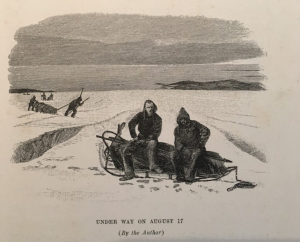 Skiing
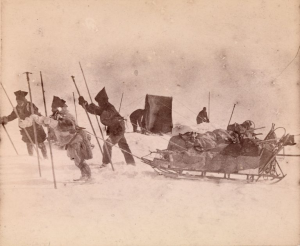
Skiing was difficult and dangerous as the landscape consisted of soft snow interspersed with crevasses. More snowstorms hindered their progress and increased effort was required to pull sledges due to the need to maintain a grip on the difficult surface. Some of the team swapped their skis for Canadian snow shoes. Balto protested that no one could teach him or Ravna anything about snow and swore that he would never put such contraptions on his feet.
Melting ice
After a few arduous days they progressed from the fissured edge of the ice cap onto the smoother, harder ice of the interior. Here, the surface was sculpted into waves like the sea. The going was slightly easier but they were plagued with thirst. They relied on collecting snow and melting it on the stove to produce drinking water but this was slow and inefficient. Nansen had the idea of adding lemon juice to crushed ice and this reduced their thirst a little.
 Sailing on
When at an estimated altitude of 2,000 metres, they appeared to be approaching the summit of the dome-like ice-cap. Nansen decided that he could try his hand at sailing. He had designed his tent so that it would come apart in a number of pieces. When the sledges were lashed together in twos and threes, these pieces could be hoisted like sails.
Change of course
Unfortunately, the wind was not in their favour. The planned destination of Kristianshaab on Disko Bay lay to the north-west, the same direction that a bitter gale was blowing from making it an impossible task. Nansen had no intention of wintering on the ice-cap so, with time running out, he conceded that they would aim instead for Godthaab (Nuuk). Although this was further down the west coast, it was 80 miles closer to their current location. With a more westerly bearing, the sails filled with wind.
The art of ski-sailing
Ski-sailing was an art in itself. The skiier could do one of two things:
- harness himself to the front of the wind-driven sledge and try to guide it, making sure that he wasn’t overtaken and mown down
- hang onto the back of the sledge, hitching a lift or simply ski alongside, going to the assistance of the others if needed.
Sight for sore eyes
“To give a description of the scenery during the day in this region is easy. We saw only three things: that was snow, sun, and ourselves…” (Nansen, SGM, 1889)
Nansen had brought several types of eye-protectors with him. Sun-blindness would be an ever-present danger. These included wooden goggles with a narrow horizontal slit for each eye, based on a traditional Inuit design. In general, he found these very serviceable but couldn’t see the ground at his feet while skiing. To remedy this, he cut a vertical slit to complement the horizontal one.
Storm in a tent
A severe gale swept down the plateau on the night of 6th September, making it impossible to see where the ice ended and the sky began. The group fought the wind, pitched the tent and hoarded enough food supplies inside to last several days. Cooking was impossible, so they ate dry pemmican. The wind tore at the canvas, forcing snow through the smallest gaps in the tent so that it swirled inside like a miniature blizzard. They sheltered inside their sleeping bags.
Back on track
By morning the storm had passed and the men dug out their sledges. The air glittered with crystals. The sun was ringed with haloes, arcs and sundogs.
“We didn’t even have time to eat. It was such fun to ski.” (Samuel Balto, from ‘Nansen’ by R Huntford)
The men’s spirits began to lift and they were all united in their joy of skiing. They travelled at night, as the northern lights played overhead, and the moon lit the snowfields with a silvery gleam. The sudden appearance of a deep crevasse at his feet stopped Nansen dead in his tracks. The smooth ice was giving way to more fractured terrain. They were nearing the coast.
Comfort
On 26th September they reached the sea at Ameralik fjord. Nansen wrote “I shall never forget what pleasure and enjoyment it was to get water again… and what a comfort it was to have any quantity of fuel, willow, and heather, so that we could make an open fire in the night and cook as much as we liked!”
Godthaab, the nearest settlement, was still 50 miles away and across a mountainous landscape. Nansen decided that it would be quicker and easier to go by sea. He and his companions set about building a boat out of willow boughs and tent canvas. Nansen and Sverdrup carried the vessel over the mud of the fjord into open water and then rowed it to Godthaab where they received a warm welcome.
Appearance
The Danish Governor welcomed the two men into his house. Nansen saw his reflection in a mirror. His hair was long and unkempt and his face was black with the filth and grease from two months on expedition. However, he was alive, and so were his men. A search party collected the remainder of the team. On 12th October they were all reunited in Godthaab.
“The expedition was finished, and Greenland was crossed for the first time.” (SGM, 1889)
Wintering in Greenland
Having arrived at Godthaab so late in the season, there was no chance of making it to Ivigtut (Ivittuut), 240 miles further down the coast, where the last Danish vessel was just about to depart for Copenhagen.
Over-wintering in Greenland was, according to Nansen, “not very disagreeable.” The team spent a lot of time shooting wildfowl, Nansen learned various Inuit skills including how to use a kayak. He described this as “the best one-man vessel in the world.”
Back home
A glorious reception awaited the men in their home countries, but when the time came for them to leave, Nansen found himself unexpectedly wistful. The words of a new Inuit friend struck a deep chord:
“We enjoyed ourselves, we lived together like brothers; but now you will travel to the unknown world out there, you will possibly forget us among all the people, but we will never forget you.” (‘Nansen’ by R Huntford)
Nansen later wrote that he and his companions “…left Greenland almost sorry to part from its happy people – those children of nature, who have no experience of the miseries of civilisation, and who do not know real poverty.” (SGM, 1889)
Acknowledgements:
View the full article at https://rsgs.org/fridtjof-nansen-the-first-crossing-of-greenland/
Special thanks to the Royal Scottish Geographical Society and Jo Woolf.
About the author:
 Jo Woolf has always had a passion for unearthing historical gems about people and places. She writes about the wonderful history and wildlife of the landscape of Argyll, Scotland, where she lives, on The Hazel Tree blog. Jo has been the Writer in Residence at the Royal Scottish Geographical Society since 2016 and is the author of The Great Horizon, 50 tales of exploration. She spends much of her time happily digging around the RSGS archives looking for exciting and interesting stories to share. Jo received the Diploma of Fellowship of the RSGS in February 2018.
