

Alexander Selkirk: The Greatest Survivor?
When we think of the greatest stories of survival there is no doubt that, for many, that of Robinson Crusoe features amongst them. It may even be at the top of the list.
Yet, Robinson Crusoe is a fictional character. He was created by the novelist Daniel Defoe for his book, generally known as ‘Robinson Crusoe’ which was published in 1719.
Defoe did not make up the story entirely. He was inspired by real life stories. That of Alexander Selkirk is usually cited as the main source of inspiration. Like many novelists, though, Defoe probably took inspiration and ideas from a variety of sources.
According to Andrew Lambert, a naval history professor at King’s College, London, Crusoe’s story is “a complex compound of all other buccaneer survival stories”. Furthermore, stories such as that of Robert Knox being ‘shipwrecked’ at Ceylon in 1659 and his subsequent forced stay on the island could have had a major influence too. Afterall, Defoe and Knox allegedly knew each other well. Then there are the stories of Pedro Serrano, Ibn Tufail’s Hayy ibn Yaqzan and, of course, Henry Pitman. The inspiration for Friday could have been Will, the Misquito Indian who had been marooned on the same island as Selkirk a few years earlier.
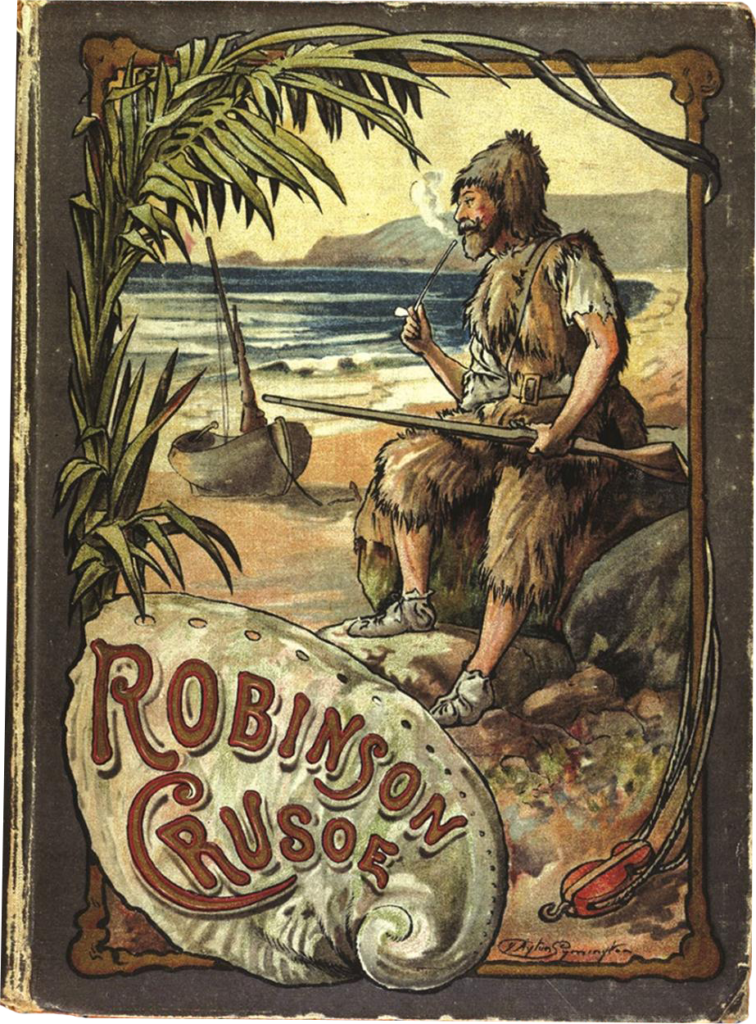
Whatever the inspiration, Robinson Crusoe is a great and classic tale. But we’re not focussing on him. We are focussing on Alexander Selkirk and his true survival story. Is he the greatest survivor of all time? More importantly, what can we learn from him?
How Selkirk came to be marooned alone is an interesting story in itself.
Background
Selkirk was born in the fishing village of Lower Largo in Fife, Scotland in 1676. He was the seventh son to parents John Selcraig and Euphan Mackie. John was a successful shoemaker and tanner and Alexander was expected to follow in the family trade. Alexander wasn’t so keen on the idea.
At this point, there appears to be a discrepancy in the surname. Selcraig or Selkirk? The spelling of his surname was changed to Selkirk at a later stage. This could perhaps have been because of mispronunciation or misspelling by others – which wasn’t uncommon at the time. Alternatively it has been suggested that it was a concerted effort to dissociate himself with his past!
“A spoiled and wayward boy”
The young Alexander progressed well at school, especially in the subjects of arithmetic and navigation. This was perhaps down to his determination to go to sea. However, he was also noted as being ‘a spoiled and wayward boy, frequently engaged in mischief of one kind or another’. This, no doubt, wasn’t helped by the indulgences of his mother. She held on to the traditional superstitious belief that seventh sons held special qualities. Qualities such as second sight!
For that reason, she encouraged him to resist his father’s wishes to assist in the family business. Instead, she encouraged him to pursue his seagoing dreams to make his fortune. This in turn led to serious disputes in the household and Alexander was threatened with being disinherited by his father. The threat was enough to keep him at home. But not enough to keep him out of trouble!
Troublesome times
Political and religious tensions were high at this time. The Catholic Stuarts had reigned in Scotland since 1371 and over both England and Scotland since 1603. However, in 1688, the Protestant William of Orange, by invitation, invaded. James II fled and, the following year, William and his wife Mary became joint heads of state. Unsurprisingly, James tried to regain his throne which led to to a number of challenges. Tensions were high and there was much political agitation.
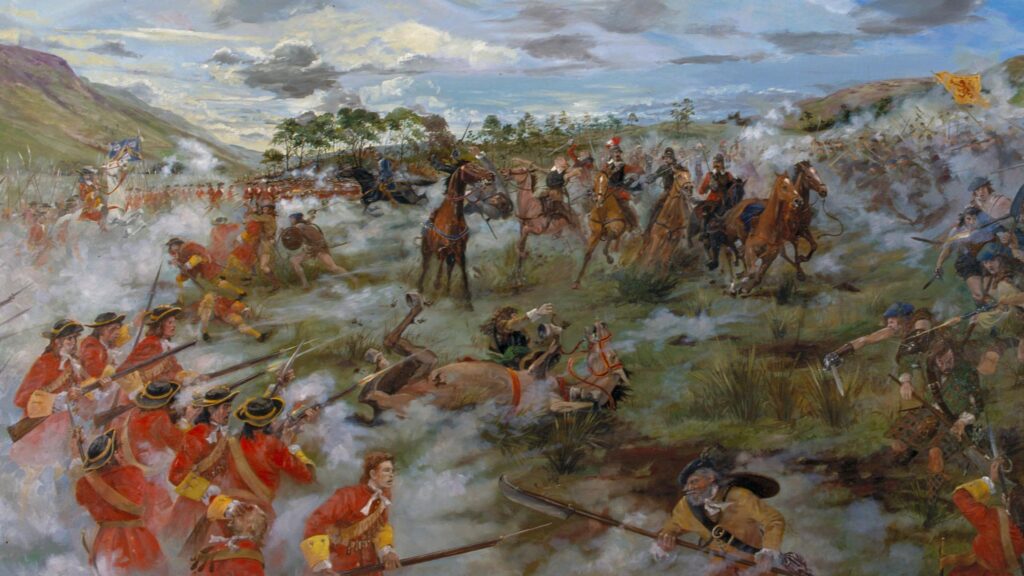
In Largo, at this time, the complying clergy were generally very disliked by their parishioners. This gave Alexander, at the age of 13, the opportunity to show his troublesome nature. Brandishing a bludgeon, he joined a mob fracas led by his brother, John. This involved preventing the Minister from accessing the church. The pastor was then ‘encouraged’ to share out the proceeds of the poor box amongst them.
Following that, his behaviour continued to get him into more trouble. In August 1695 he was called to appear before session for indecent conduct in church. Selkirk, now 18, failed to attend, and left for sea instead.
Family fighting
He returned six years later in 1701 and, again, through his disagreeable nature caused more problems. He beat up his younger brother who had laughed at him for drinking salt water by mistake. A family row ensued and Selkirk even had to be barred from getting his pistol. Whether he would have used it in his anger or not is open to debate. He also assaulted his father and brother in law. All in all, it appears that Selkirk was a quick tempered, disagreeable character. He was certainly not behaving in the manner that his strict religious upbringing required of him.
The family believed that, in those years away, Selkirk had taken up ‘with the Buccaneers in the South Seas’. This was thought partly because of his behaviour and his possession of the pistol. Discovering later that he had become Sailing Master of the Cinque Portes galley provided more circumstantial evidence of this. This was a role that would need to be filled by an experienced and well suited person to the buccaneering life. Furthermore, it has been suggested that Selkirk was part of a Scottish colonising expedition of New Caledonia in what is now Panama. This, though, would only cover a short part of those six years.
Interestingly, Bruce Selcraig, a direct descendent of Selkirk’s oldest brother, gives a view in the Smithsonian Magazine. “Selkirk was a bit of a bastard, more respected in his absence than his presence.”
William Dampier and privateering
In the Spring, Selkirk left Largo again and sailed for England on the first ship that required his services. He, allegedly, yearned to return to the South Seas.
At this time the War of the Spanish Succession had started and was in full flow. With that, came the legal sanctioning of the plundering of enemy ships. This was known as privateering or, in other words, legalised piracy. Spanish and French vessels became legitimate targets.
One such person looking to profit from this was Captain William Dampier. Dampier, was arguably the best known and renowned adventurer of the time. His book ‘A New Voyage Round the World’ recorded his adventures of sailing in the South Seas and the East Indies. It was immensely successful.
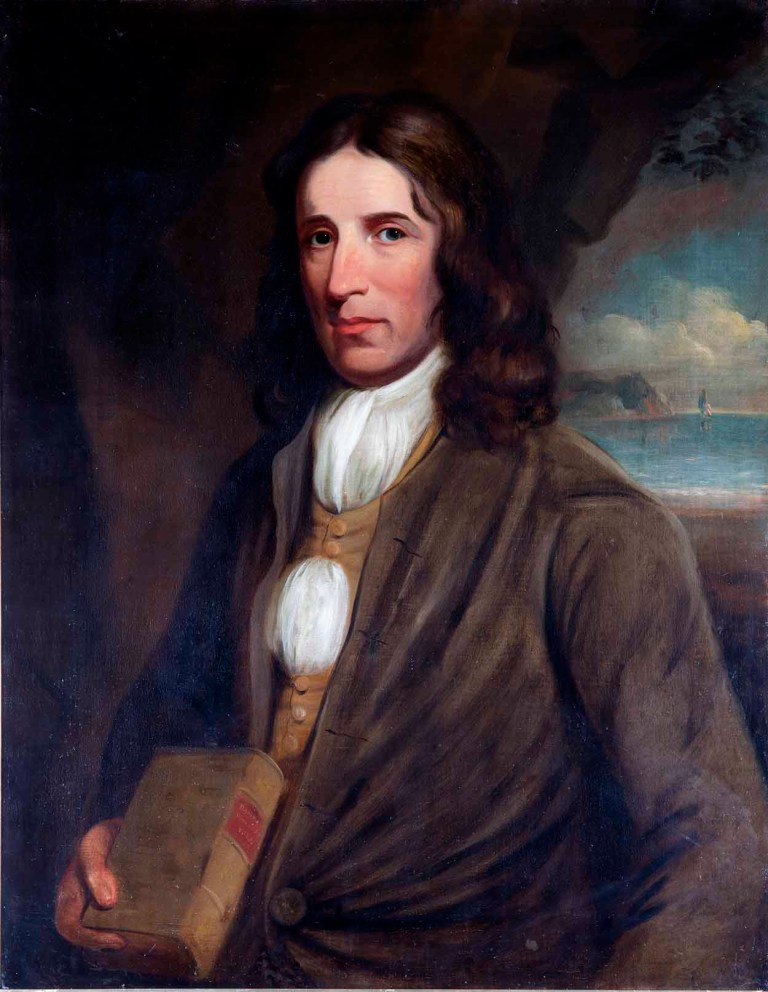
His reputation as a chronicler and hydrographer within the Royal Society meant that in 1699 he was appointed to command the Roebuck, a naval ship, on an expedition to explore New Holland (Australia) and the East Indies. However, returning in 1702 from the disastrous expedition, he was court martialled. He was found to be ‘not a fit person’ to command a naval vessel.
Fortunately for Dampier, private men-of-war ships were crewed by merchant mariners. This meant they could be led by commanders who were not required to have naval commissions.
The plan for riches
Dampier was well known as a buccaneer. Despite his reputation having suffered from the court martial, he persuaded merchants to outfit two ships. These would sail on a privateering expedition to the South Seas. In this he, and a Captain Pulling, would capture one or more of the Manila Galleons. These were the Spanish galleons noted for the wealth they carried. They often harboured on the River Plate near Buenos Aires.
If they amassed £600,000 in the capture, they would return home. Otherwise they would then plunder the Baldivia (Valdivia, Chile) ships off the coast of Peru en route to Lima. These should be laiden with gold. If that failed, they would attack rich towns as well as the Acapulco ship that was alleged to be worth ‘thirteen or fourteen million pieces of eight’.
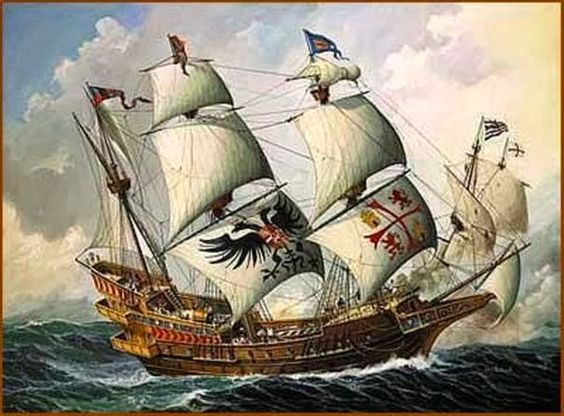
The St George and the Fame, each equipped with 26 guns, were issued a Letter of Marque. They were commissioned and sanctioned by the Lord High Admiral of England, HRH Prince George.
It was a well put together plan. But, as Robbie Burns would state nearly 80 years later, ‘The best laid schemes o’ Mice an’ Men Gang aft agley’.
Stormy argument brings in Selkirk
Just before they were set to sail, Dampier and Pulling had a huge argument. Consequently, Pulling went his own way, allegedly sailing for the Canary Islands. He was never heard of again!
A replacement had to be found, so the smaller Cinque Ports was equipped to take the Fame’s place. And so, Selkirk, Sailing Master of the Cinque Ports comes into Dampier’s story. The St George was anchored at Kinsale, on the coast of Ireland, on 18th May 1703 and was joined by the Cinque Ports after a substantial delay.
Dampier was in overall command and was supported on the St George by Lieutenant Griffiths, Chief Mate John Clipperton, Second Mate William Funnell and John Ballet, the Surgeon. The officers of the Cinque Ports galley were Captain Charles Pickering, Lieutenant Thomas Stradling and, as previously mentioned, Alexander Selkirk.
Murder at Kinsale
Dampier wasn’t the only one to get into arguments. Only a few days before the ships were due to sail, Lieutenant Griffiths was murdered. Onshore drinking with Captain Charlton of the Rye Galley, for whatever reason, there were heated words between the two. This resulted in Charlton killing Griffiths.
Lieutenant Huxtable was brought in as a replacement.
The Voyage to the South Seas
Because of the long delay at Kinsale, the ships didn’t set sail until 11th September. Not long after setting sail, following a massive row between Dampier and Huxtable, Dampier ordered that the ship return to Kinsale to put Huxtable ashore. Although Dampier changed his mind, it turned out to be the first of a series of disputes between him and his officers.
The journey was very eventful. It was full of misfortune, bad timing, arguments, fighting and plundering. The map and ‘diary’, below, highlight many of the recorded events. Note that 24th November was a turning point for Selkirk.

11th September 1703
St George and Cinque Ports set sail from Kinsale. Following a row with Huxtable, Cape Dampier orders the ship return to port. Dampier later reversed the order.
25th September
Arrive at Madeira. Received information that the Manila galleons had left Buenos Aires and safely arrived at Tenerife. A council was held. It was agreed to relinquish the original plan and head for the richer towns on the Spanish Main instead.
28th September
Set sail from Madeira.
30th Sept
Islands of Palmas and Ferro (Canaries) sighted. Continued towards Cape de Verde islands (Cape Verde).
6th October
Arrived at Mayo (Maio, Cape Verde). Raid planned to steal salt (main produce of the island). Surf was too bad to land so plan was abandoned.

7th October
Sailed for St Jago (Santiago). Anchored at Prior Bay (Praia Bay). Men refreshed. Stocked water. Inhabitants described as the most depraved race to all kinds of vice!
18th October
Capt Dampier and Lt Huxtable argue again. Dampier sent Huxtable ashore at midnight and sailed without him early morning. No council held. No plan. Officers not pleased. James Barnaby promoted to 1st Lieutenant.
2nd November
St George and Cinque Ports cross the equator.
15th November
Arrived at the island of St Ann, Brazil. 14 or 15 of the crew fell sick with a fever. Boats sent ashore. Crew cut wood. No fresh water.
24th November
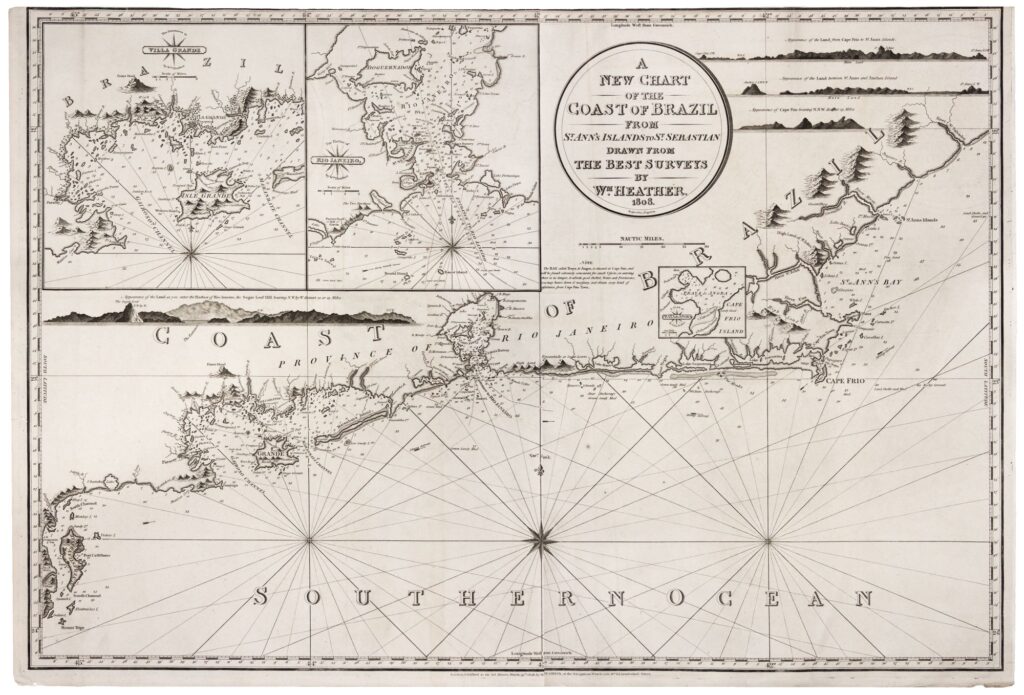
Anchored at the uninhabited La Granda (Isla Granda, Brazil). Collected water and more wood at the site of former town of La Grand. Captain Pickering died. Burial held. Pickering had been viewed as ‘the main prop of the expedition’. Stradling appointed in his place. This was a major turning point for Selkirk. Pickering’s death marked the likelihood of the expedition being unsuccessful. Selkirk did not get on with Stradling. He also had a dream or forewarning that the expedition would fail and the Cinque Portes would be shipwrecked. He therefore determined to leave the ship at the first possible opportunity.
Dampier argued with Lieutenant Barnaby. Barnaby, along with eight of the crew of the St George, left the vessel. This was a deserted island with wild beasts. Bigger fear was being caught by the Spanish who would enslave them forever. Council held: decision to head for Juan Fernandez Island (Más a Tierra).
8th December
Left La Granda.
24th December
Islands of Sebald de Wert sighted. (Named after Dutch explorer Sebald de Weert who is credited for the first sighting. These have since been renamed and part of what are now known as the Falkland Islands).
4th January 1704
Cinque Ports lost sight of St George. This was a result of severe storm which continued for several days.
10th February
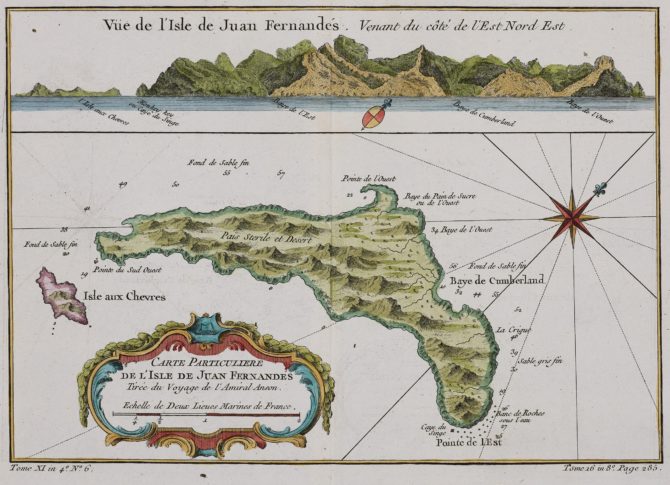
Cinque Ports arrived at Más a Tierra in the Juan Fernandez Archipelago. Anchored at the Great Bay (Cumberland Bay) and waited.
13th February
St George sailed into Cumberland Bay. Delay allegedly caused by a navigational error of Dampier’s.
While at Más a Tierra the crews were kept busy collecting wood and water, refitting and hulling the ships.
A violent quarrel broke out between Stradling and his crew on the Cinque Ports. 42 of the 60 went ashore and refused to return. Whether Selkirk was part of this group or not is not known. He was certainly no admirer of Stradling! After a couple of days, Dampier persuaded them to return.
On voyages such as this it was important to conserve supplies. Food was supplemented by catching goats and young seals for their meat. Oil from the fat of sealions was used for frying fish. It was also used as fuel for lamps. The tops of cabbage palm (more accurately cabbage tree or Dendroseris litoralis) were used as vegetables.
29th February
A ship came into view. St George and Cinque Portes quickly headed out to it so hastily that St George’s long boat and five of Cinque Ports’ crew (and a slave or servant from St George) were left behind. A boat from Cinque Ports, with a man and a dog on, broke loose.
St George caught up with the ship. It was French, well provided and manned, with 30 guns. Fought for 7 hours. French ship about to yield but a breeze sprung up and she made sail. St George not in a state to follow. Lack of wind had prevented the much smaller Cinque Ports from fully engaging. St George refitted quickly. Crew wanted to catch the French ship as news reaching the Spanish could scupper the success of the expedition. Dampier wouldn’t agree. He and Stradling agreed to let the ship escape. Crews not happy. Decided to return to island to collect equipment and those left behind.
3rd March
Island back in sight but sea was so calm that Cinque Ports was rowed in. Two French ships, each with 36 guns, were anchored there. Shots were fired. Cinque Ports headed back out to St George. Council held: decision made to head for Peru. French had collected the man and dog and captured four of the men left on the island. The other two hid.
6th March
St George and Cinque Ports set sail.
14th March
Sailed past Capiapo (Copiapó, Chile). Unable to land for provisions and refreshment because of loss of boats.
19th March
About 10 leagues from shore, the sea became as red as blood as far as the eye could see. All worried. Sounded 170 fathoms but didn’t reach seabed. Drew water and filled a glass. Stayed red for 15 minutes then red matter floated to top. Slimy with spots. Concluded it was fish spawn.
22nd March
Lay to just off Lima. Remained in hope of plundering ships till 5am. No ships so sailed off. Nearly wrecked on the rocks of the Omegas.
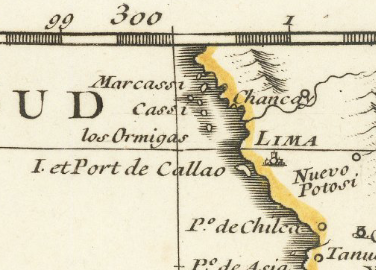
Sailing north. Spotted two sails. One was the French ship previously fought with. Gave chase. St George pursued it. Cinque Ports went after other ship. Dampier hesitated about what they were doing and the two ships escaped into port. Crew very unhappy.
24th March
Captured a Spanish ship, with no resistance, while heading north. Cargo included Flanders lace, silks, pitch, tar, tobacco, snuff etc. Took off what was wanted. Let it go on 30th. It headed for Lima.
31st March
Near to port of Paytu (Paita). Captured another Spanish ship after firing a few shots. Indigo, cochineal etc.
4th April
Ship let go after some goods removed. Crew, again, not happy. Dampier said they would go to a rich town and be fully rewarded.
5th April
Preparations made for attacking a town. Carpenter fitted pateraroes (pedreroes) to the two Spanish longboats. A pedrero is a type of short-barrelled cannon used to fire stones, nails, broken-iron etc.
11th April
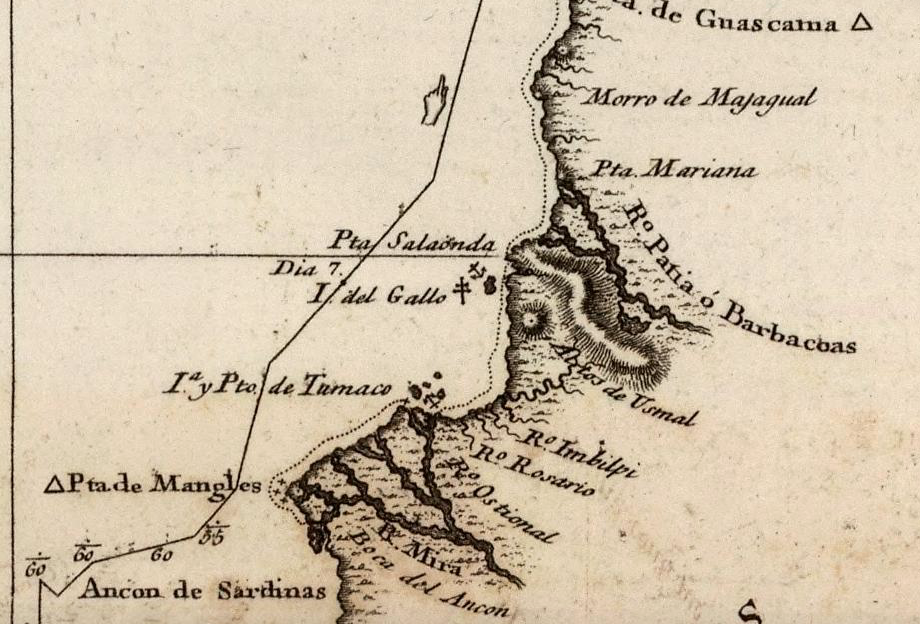
In sight of Gallo (Isla del Gallo, Colombia). Captured a bark (barque) which was laden with planks. Its crew escaped on boats to the shore.
12th – 17th April
Anchored at Gallo. Uninhabited.
17th April
About to leave when a vessel, heading for the River Tumaco, came into sight. Its captain mistook St George and Cinque Ports for Spanish and hoped to buy provisions. Vessel captured. Discovered a captured Guernseyman onboard. He’d been cutting logwood in the Bay of Campeachy (Campeche, Mexico) with others but wandered off and was captured. Treated harshly, imprisoned in Mexico for two years. No chance of release unless he converted to Catholicism. Any European captured by the Spanish in the South Seas was not allowed to return to their home country. He eventually converted but had to either stay in Mexico or serve on a Spanish ship in the South Seas. Delighted to be rescued.
Left Gallo. Heading north. Dampier announced target as Santa Maria. He had been there previously in 1680 with the buccaneers and believed there would be plenty of gold. Last captured sloop was sunk and its Indian captain was promised a better ship if he would pilot them up to the town. He agreed.
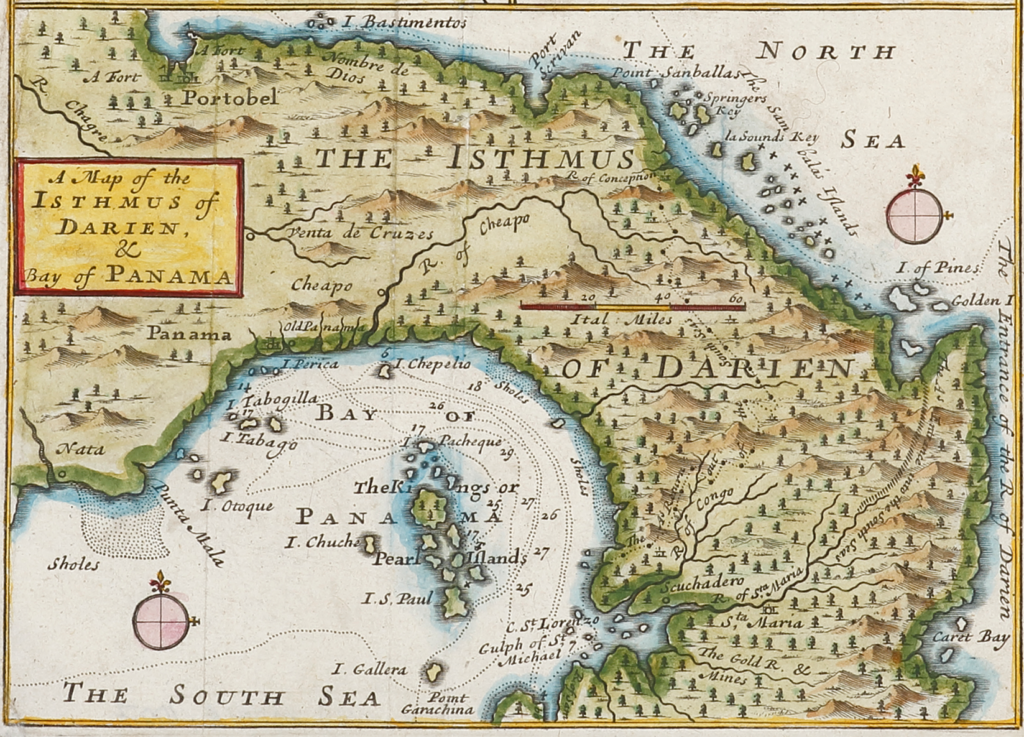
25th April
Anchored at Point Garachina (Garachine, Panama). This is at the southern extremity of the Bay of San Miguel in the Bay of Panama.
60 of the crew were left with the ships. Dampier, Stradling and 102 armed seamen, headed off in three Spanish launches for Santa Maria. The strong ebb tide flowing out from the Santa Maria River resulted in no headway being made. Consequently the decision was made to set anchor for the night. There was no shelter in the boats and a thunder and lightning storm was raging. The men had a very uncomfortable night. Daylight came but the tide was still not favourable.
During their wait, a canoe with five Indians came near and asked where they had come from. Dampier instructed their Indian pilot to say they were from Panama and to invite the Indians aboard. At this, the Indians made their escape. Dampier ordered to fire at them and sent one of the launches in pursuit. No doubt the Indians would raise the alarm in the local villages. Stradling and two launches, with 22 men in each, set off immediately to take the town of Schucadero.
As the launches entered the Santa Maria river, they saw a canoe with three Indians coming from the Congo river. Not having been seen by the Indians, they hid and were able to capture them. They tried using the Indians to help them find Schucadero but they managed to escape by jumping overboard. One of the men fired a shot at them. A gun shot from the river bank was heard in reply. After landing, the town was taken without resistance. The inhabitants had all fled having had prior warning. Plenty of provisions were found and there was an abundance of fruit trees too.
26th April
By morning, Dampier had still not arrived in the bark so Stradling sent a canoe off to find him. He had sailed past the mouth of the river and set anchor for the night. Remained till noon when the breeze had got up again.
Stradling’s men updated Dampier on what had happened and gave him packet letters that had been taken from the three Indians. These turned out to be from the president of Panama, sent seven days before. They stated that 250 Englishmen from Jamaica had landed on the north side of the isthmus and were heading for the town. 400 soldiers were on their way and should arrive before the letters did.
30th April.
Afternoon. 87 men onboard the three launches and canoe set off up the river for Santa Maria. Clipperton, Funnel and the remainder stayed with the bark. However, when within a quarter of a mile of the town they were ambushed from the banks of the river. One man was killed and another wounded. Fighting back, the enemy were forced out of their concealments and Dampier’s men were about to land. Dampier then lost his nerve. He stated that the Spaniards must have known they were coming. Any items of value would have been carried off into the woods. They should therefore return to the bark.
1st May
Daybreak. Headed back to ships at Point Garachina.
6th May
Arrived poorer than before. Very few provisions. Much discontent. A ship anchored by them at midnight. It was boarded and captured. It was full of flour, sugar, brandy, wine, marmalade of quinces, salt, linen and woollen cloths. Funnel was put in charge of the prize, with Selkirk alongside. The bark, no longer needed, was sunk.
Headed across the bay of Panama to the King or Pearl Islands.
14th May
Near Tobago (Toboga). Anchored to rummage prize.
18th May
A small bark came into sight. Longboat and canoe dispatched after it and took it. Only a small sum of money. Stradling kept the bark for himself. Passengers said there was $80,000 concealed in the ship which had been smuggled onboard. Dampier wouldn’t believe it so let the bark go. Stradling and Dampier had a huge argument about it and decided to separate. Five men left the St George to join the Cinque Ports and vice versa.
19th May
Ships went their own way. Selkirk stayed with Stradling, no doubt believing that under Dampier the expedition would be a failure.
Rank mutiny
Up until the end of August, the Cinque Ports cruised along coast of Mexico and islands. Meanwhile the St George ventured along the coast of Peru.
Selkirk and Stradling had a violent quarrel and Selkirk decided he would leave. The Cinque Ports sailed to Juan Fernandez for provisions and a much needed refit. Here, they would also collect the men and stores that had been left there. The ship was in bad condition.
While the Cinque Ports underwent repairs, the arguments became worse. Selkirk decided to be left on the island. He remained adamant that the galley was in no condition to carry them home. A major concern to him was that the Cinque Ports had not been covered in protective wood sheathing. Consequently, the ship was suffering badly from shipworm infestation and, despite repairs, was still not fit to sail.
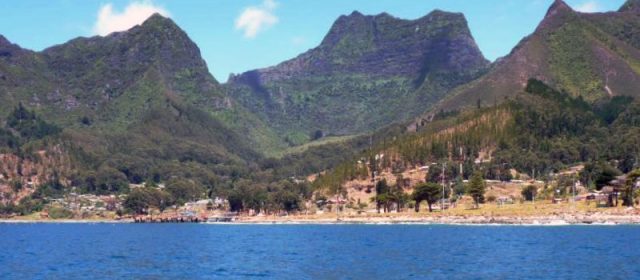
With a sense of freedom and joy he was taken ashore with all his belongings. He bid farewell to his colleagues but Stradling was eager to get back the ship. Once reality hit, Selkirk rushed into the water, imploring them to return and take him back. Stradling refused, saying the situation was appropriate for his ‘rank mutiny’.
Marooned
And so starts Selkirk’s time alone on the island. The only possessions he had were:
- a chest which contained some clothes and a quantity of linen
- his musket
- a pound of powder and proportionate amount of ball
- knife
- hatchet
- a pewter kettle
- a flip can
- some tools and mathematical instruments
- a few pounds of tobacco
- some books on navigation.
- a copy of The Bible and some devotional pieces
For many days he sat on his chest looking out to sea, hoping his shipmates would return for him. He did not eat or try to sleep.
Eventually, in extreme hunger, he fed on seals and shellfish that he could find along the shore. According to Steele, in his article based on an interview with Selkirk, he also ate turtles. This has been dismissed by others saying that turtles are not found in the Juan Fernandez Archipelago. Despite that there are reports of sea turtles having been caught in the area. Perhaps he did eat some afterall.
He didn’t want to leave the beach and also wanted to conserve his powder. Selkirk didn’t enjoy his food at all. Fish gave him diarrhoea and he could only stomach seafood as a ‘jelly’. He desired salt and bread but later became reconciled to the fact he would not get it.
Lowest ebb
In October 1704 it was now spring. Despite that, he was very depressed. He was all alone and had no one to talk to or share with. Furthermore, the noise of seals during the night and the crashing of falling trees and rocks increased his fear. He seriously considered suicide.
However, at his lowest ebb, he reflected on his religious upbringing and took a more spiritual outlook to his situation. He began viewing the uninhabited wilderness as a smiling garden and became reconciled to his fate. With winter approaching, he decided that a shelter would be needed. Even at this latitude there could be frost and snow. And so, Selkirk’s tale becomes one of survival skills.
Surviving alone on the island
Building a hut was Selkirk’s first real task. Prior to that he had only been foraging along the seashore. Now he had to spend more time away from the shore and it took his mind off the preoccupation of waiting to be rescued. However, it was not until eighteen months had passed before his mindset had improved fully and he could stay away from the beach for a whole day.
Selkirk built two huts using wood from Pimento Trees and thatched them with a tall grass that produces a straw similar to that of oats. One hut was much larger than the other and was located near a spacious wood. This would be his sleeping room. He constructed a bed frame and spread the bed clothes he had brought from the Cinque Ports on it. These bed clothes, when they were repurposed or had worn out, were later replaced with goat skins.
The power of worship
This hut was also used as his chapel and he began to worship in the same way that he used to with his family. In the morning, he would sing a psalm and recite scripture and pray before getting on with his tasks for the day. In the evening, before settling down to sleep, he would worship in the same manner.
Part of this was to help maintain his speech and to actually hear human voice even if it was his own. However, he spent a lot of time in the act of devotion and later admitted that he was “a better Christian in his solitude than ever he was before, and feared he would ever be again.” To distinguish the Sabbath from all other days, he allegedly kept an exact account of the days and weeks for his whole stay on the island.
A smaller hut, erected some distance away from the larger one, was used as a kitchen. It was scantily furnished with rudely constructed items. He made a spit and used the pot or kettle he had brought from the ship to boil meat in.
Food, fun, fire and fuel
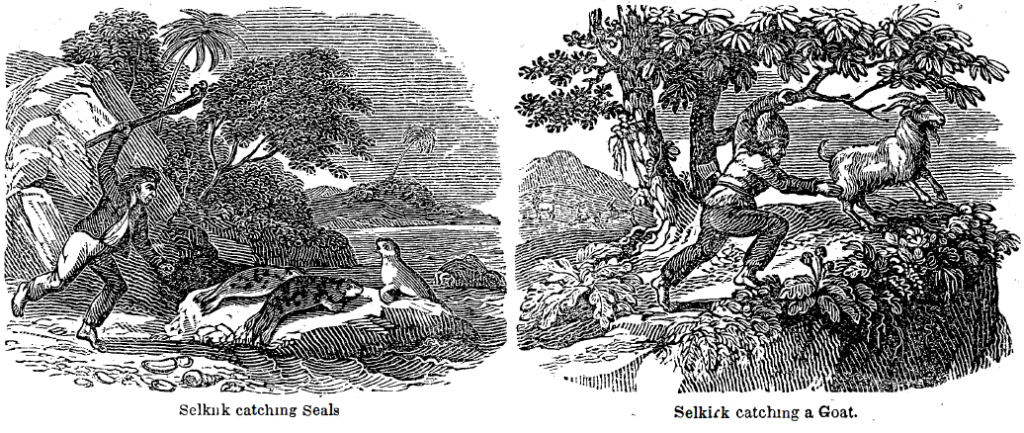
A group of surprisingly tame goats browsed around his hut. He would take young ones and lame them. This was enough to slow them down rather than to injure their health. When he needed to catch them he would be able to easily. These were kept as an emergency store in case he became ill or had an accident and couldn’t catch others. His only method of catching goats was by running and catching them. The powder and ball for the musket must have been used up by this stage.
Pimento wood was used as fuel and as candles. It burns bright and clear and gave a nice perfumed aroma.
To make fire he used what is described as the ‘Indian method’ ie rubbing two pieces of pimento wood together until they ignited. Although he had linen which could have been used as a tinder to speed up the process, he could not afford to waste it. Furthermore, he had plenty of time and the labour kept him amused.
The benefit of provisioning locations in the age of sail
In the age of sail it was essential to have reliable provisioning locations for ships on incredibly long voyages. Más a Tierra happened to be one of these with attempts at setting the island having been made. Consequently, previous ‘settlers’ had introduced goats and planted some crops. Selkirk benefitted from this. And of course there were endemic plants that were edible too.
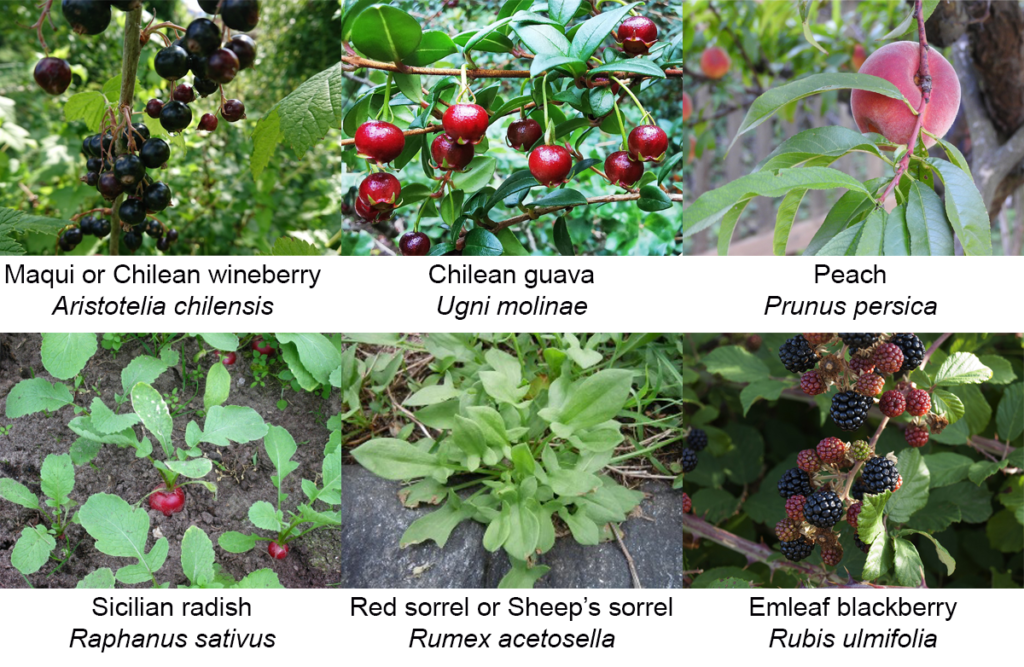
He began to enjoy a greater variety of food too. He would either boil or broil crawfish, some of which weighed eight or nine pounds, and he would season it with pimento (Jamaica pepper). The lack of salt was no longer an issue. There was plenty of ‘cabbage palm’ on the island so he would use this in place of bread. He would also use turnips, or their tops, and a type of parsnip that had a good taste. There was Sicilian radish, wild sorrel and watercress which he found in nearby streams. He also found other vegetables peculiar to the local area. Small black plums and pumpkins have also been mentioned in accounts. He would eat these with fish, lobster or goat meat.
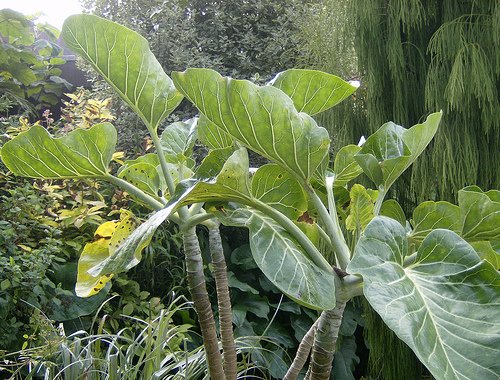
Unfortunately, there is little recorded evidence of when exactly things were introduced to Más a Tierra. This means that Selkirk may not have had access to certain edibles that we know are there now. However, we do know that some introduced species on the island were first reported in the mid 1700s and 1800s. On the other hand, despite quince trees having been reported in 1624, no later accounts mention it. Others, such as the peach and the fig, would have been identifiable enough for Selkirk to have described.
Some introduced plant species:
- Peach (Prunus persica)
- Common fig (Ficus carica)
- Sweet chestnut aka Spanish chestnut (Castanea sativa)
- Elmleaf blackberry aka thornless blackberry (Rubus ulmifolius) – fruit edible raw or cooked
- Chilean guava (Ugni molinae) – edible berries
- Maqui aka Chilean wineberry (Aristotelia chilensis) – small edible fruit
- Red sorrel aka sheep’s sorrel, field sorrel and sour weed (Rumex acetosella). The leaves can be eaten raw or cooked. Can be used as garnish, flavouring, salad, curdling agent in cheese making.
- Slender wild oat (Avena barbata). This could have been the grass that Selkirk used to thatch his huts.
Selkirk was now incredibly content. The climate was generally good, food was aplenty and his mind was soothed by his religious devotion. He actually took delight in everything around him now. He decorated his hut with fragrant branches.
Rats and cats!
On the other hand, during the night while trying to sleep, rats would annoy him by gnawing on his feet and other parts of his body. As a solution, he caught and tamed some of the cats which ran wild on the island (these, or their ancestors, had been left by previous visitors to the island, as had the goats). The cats got rid of the rats and became companions to Selkirk too. He even ‘taught’ the cats to dance. The cats prospered and bred so quickly that there were hundreds of them. Selkirk worried that, in the event of his death, there would be no one to feed the cats and that, in the absence of anyone to bury his body, the cats would feast upon him!
Selkirk’s health and strength improved. Whereas early on he could only outrun kids, he was now strong enough to overtake and catch the strongest goats. He would then throw these over his shoulder and carry them back to his hut.
New clothes
When his clothes wore out and needed to be replaced, he made his own. Dried goat skins were sewn together using a sharp nail for a needle and long, thin leather thongs he had cut for the purpose. In this manner, he made a cap, jacket and short breeches. Although the clothes were rough they gave a lot of protection when rushing about in the undergrowth. He also made shirts from the linen cloth he had, again using the nail as a needle. However, for thread he unravelled his worsted stockings. When his shoes wore out he did not bother to replace them and this caused him little, if no, discomfort.
Hunting and scavenging
A moment of great joy came, when wandering along the shore, Selkirk found some iron hoops which he must have seen as being a very useful resource. From these he made knives, including a two feet long ‘chopper’. Although not the best made of knives they stood him in good stead during his time on the island.
He got to know the local area incredibly well and became very confident in bounding from crag to crag and sliding down precipices.
Hunting became a game. He would run down the goats, slit their ears and let them escape. Any young ones would be taken back with him to tame and they would later provide him with milk. He would also dance with these goats, as he did with the cats.
Dangerous living
It wasn’t always plain sailing. Whilst lunging to catch a goat he, and it, fell over a precipice which had been concealed by some bushes. Selkirk was stunned and bruised by the fall, unable to move for two or three days. The goat had been even less fortunate and was lying dead, underneath him. He managed to crawl back to his hut, about a mile away, where he then lay on his bed, in severe pain and unable to move, for another week.
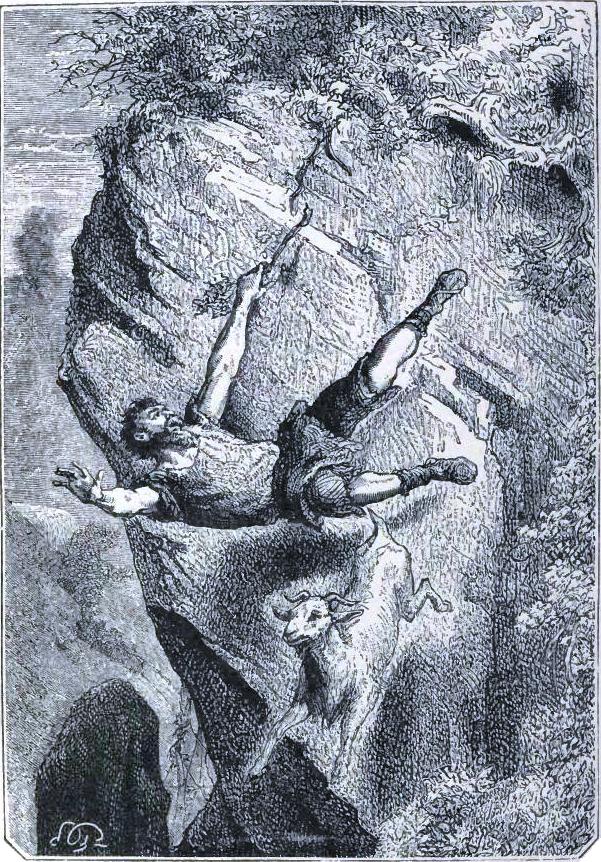
There is some contradiction about the length of time Selkirk lay there for. One source states 24 hours and another states 3 days. However, these will have both been based on talking to Selkirk. Selkirk, himself, said he calculated the time based on the moon’s growth from his last observation of it the night before the fall.
Despite that, Selkirk did considerably better than some. The island wasn’t completely safe. The northern part of the island, where Selkirk lived, consisted of high, craggy precipices. Here the soil is loose and shallow so trees that grow there are easily uprooted. One man from the Dutchess, one of the two ships that arrived and rescued him, while searching for goats, grabbed a tree to aid his ascent but it gave way. He grabbed another which also gave way and he consequently fell amongst the rocks and was dashed to pieces. Another man experienced a similar thing but survived.
At times Selkirk would amuse himself by carving his name, the date he was left on the island and adding the current date from time to time. However later searches, following Lord Anson’s arrival in 1741, for evidence of this proved fruitless.
Friend or foe? Rescue or imprisonment?
As expected, Selkirk did hope to be rescued and, on a number of occasions, he observed vessels sailing by. However, on two occasions during his stay, ships came in to anchor. Unfortunately neither were English (or British after the Union of the Crowns) or allied so he remained concealed. Death or a life of slavery or imprisonment would not be preferable to being alone on the island.
On one of these occasions he tried to see if the ship was French or Spanish. If it was French he would give himself up but not if it was Spanish. The Spanish would probably kill him in cold blood or force him to work a life of drudgery and misery in the mines of Peru or Mexico. The best outcome would be forced to become a Roman Catholic and pass his weary days in the coastal vessels of the Pacific Ocean, never to return to Europe!
However, he ventured too close and was spotted. He was pursued and shot at but managed to climb up a tree. The pursuers stopped close by but did not see him. They killed a few goats and then returned to their ship which left soon after. Selkirk would not have been deemed a valuable prize.
Still longing to return home, he continued to keep a lookout for sails approaching. On 31st January, 1709 Selkirk could hardly believe his eyes when, what he perceived to be an English ship, came into view.
He prepared wood so that he could set a fire, as soon as it was dark, to attract the ships’ attention. Once night fell, he lit the fire and kept it going all night.
The Rescue
Woodes Rogers, ‘Commander’ of both the Duke and the Dutchess sailed from Cork on 1stSeptember 1708. This was a very similar expedition to that of Dampier.
Approaching Juan Fernandez, in order to stock up with fresh water and any other provisions they could acquire, they spotted smoke. Knowing the island to be uninhabited, this was a concern.
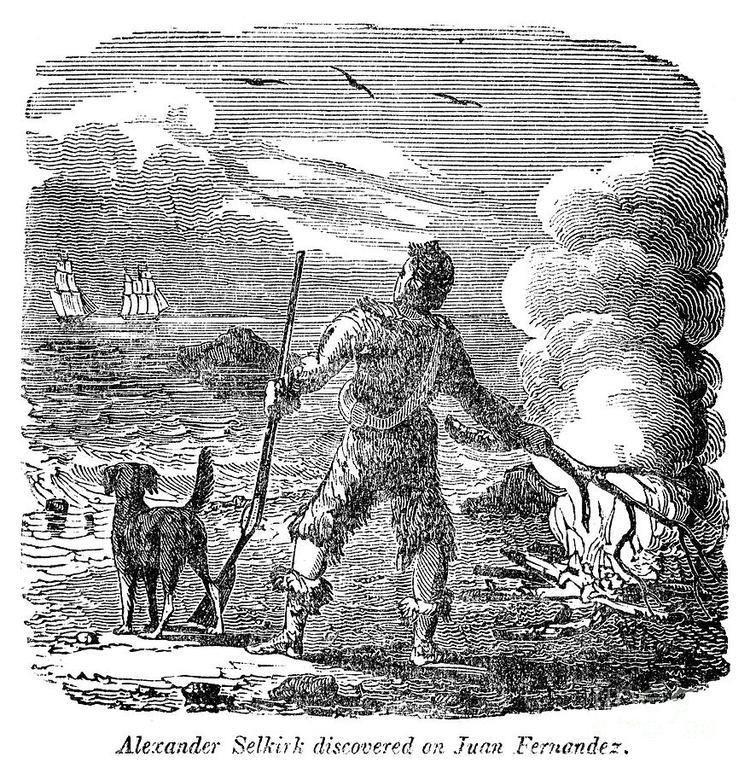
It was believed the fire could be from French who had anchored. In need of resupplying with water and any other refreshments available, the crews prepared to fight.
The following day, having seen no vessel, a boat was sent to shore to find the cause of the fire and check that all was safe.
Selkirk saw the boat leave the Duke, picked up a stick with a piece of linen tied to it and ran to meet his saviours. The makeshift flag was waved to attract their attention to him. He guided them in to a safe place to land and embraced them all on arrival. His excitement was so great he initially couldn’t talk.
The men were so astonished by Selkirk’s wild appearance that they were also struck dumb! His feet and legs were bare, his thighs and body covered in the skins of wild animals. And he had a very long beard.
Fortunately, all were able to talk soon after. Edward Cooke, captain of the Dutchess, stated that Selkirk was initially speaking in half words through lack of practice. But this gradually improved. Selkirk was invited back to the Duke.
Difficult dilemma
He enquired if a certain officer was on board. On discovering he was, Selkirk chose to remain in his solitude on the island rather than go aboard. However, on being informed that Dampier was not in command, he chose to be rescued. Selkirk and Dampier had no personal enmity but the experience of the expedition must have influenced his thoughts. Dampier, on the other hand, said that Selkirk had been “the best man on the Cinque Ports”
Selkirk spoke of his time and experiences on the island and they discovered he had lived there completely alone for four years and four months. Rogers humorously referred to Selkirk as ‘the Governor’ of the island. He described him as ‘a man cloth’d in Goat-Skins, who look’d wilder than the first Owners of them.’ However, Rogers immediately engaged Selkirk as a Mate on the Duke due to the excellent character reference he was given.
Selkirk the huntsman
The ships stayed at the island until 12th February. In this time the ships were refitted and any stores they could obtain taken onboard. Sails were taken ashore to be repaired and to make tents for the sick.
Selkirk became their huntsman and procured fresh meat. The crew were astounded by his strength and agility. The ships’ fastest runners and a bulldog were sent with him hunting but he quickly left them far behind and tired out before returning with two goats on his back.
Difficulties readjusting
Eventually, they set sail and Selkirk faced similar problems to those he first had on the island. He couldn’t bare the salt food and didn’t like spirits. He struggled with shoes, finding they made his feet swell. Although his old seaman habits did return, he avoided the usual associated vices, perhaps as a consequence of his rediscovered religious devotion.
As for the special qualities of being the seventh son, including that of second sight or even foresight, I’ll let you decide for yourself. However, not long after Selkirk was marooned, the Cinque Ports did sink! Only Stradling and eighteen of the crew survived but were taken prisoner by the Spanish.
Legacy
In 1966 the Chilean government renamed Más a Tierra as Robinson Crusoe Island and Más Afuera as Alejandro Selkirk Island. Alexander Selkirk didn’t even set foot on the island that was eventually named after him! Although the renaming was primarily to increase tourism, it does highlight the importance of the connection between Alexander Selkirk, Robinson Crusoe and the Juan Fernandez Archipelago.
The real Robinson Crusoe?
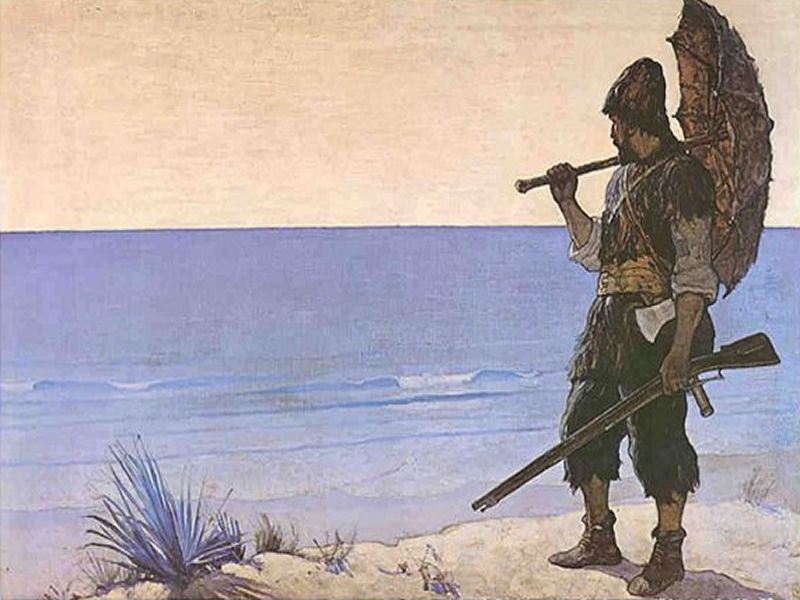
Despite Alexander Selkirk often being regarded as the real Robinson Crusoe, the two are very different.
Differences:
Alexander Selkirk was Scottish, Robinson Crusoe was English. Selkirk was a privateer, or perhaps even a pirate, Crusoe was a trader. Whereas Crusoe was marooned on an island as a result of a shipwreck, Selkirk chose to be left. Despite a change of heart, he was abandoned by the captain and crew of the ship he sailed on.
The island of Más a Tierra, where Selkirk was marooned, is 400 miles off the coast of Chile, ie on the western side of South America. Crusoe was marooned on a Caribbean island, ie on the eastern side of South America and much closer to the equator.
Selkirk’s island was uninhabited so he was completely alone, Crusoe’s was not and he befriended ‘Friday’. Selkirk was stranded for four years and four months, Crusoe for 28 years. Whereas Selkirk faced the danger of being captured by the French or Spanish, Crusoe had to contend with cannibals and tsunamis!
Similarities:
According to writer and journalist Robert McCrum, in ‘The 100 best novels‘, Defoe’s novel follows ‘an almost biblical pattern’ of:
- transgression (youthful rebellion)
- retribution (successive shipwrecks)
- repentance (the painful lessons of isolation)
- redemption (Crusoe’s return home).
This is not dissimilar to Selkirk’s experience although the details may be different. However, there are other similarities. Both Selkirk and Crusoe began their lives with different surnames to those they were later known by (Selcraig and Kreutznaer). Neither wanted to pursue the career that their families expected of them (tanner/shoemaker and lawyer). They both made clothes from goatskin. And so on.
In other words, Alexander Selkirk was not Robinson Crusoe but Defoe must have been influenced by the stories of this great survivor. It would have been incredibly remiss of Defoe not to have used Selkirk’s experience as a basis for some of Robinson Crusoe.
What we should learn from Selkirk’s experience:
Based on Selkirk’s highs and lows there are some very important learning points for anyone who finds themselves in a similar situation:
- Adopt a survival mindset from the very start.
- Keep yourself occupied:
- set tasks and goals eg building a shelter.
- develop games/entertainment.
- Take on a ‘spiritual approach’ to your situation.
- Ensure good physical exercise and wellbeing
- Talk and sing to yourself (and anything else that will listen!)
- Build up local knowledge.
- Domesticate animals, if possible eg goats for meat/milk and cats for company/pest control.
- Vary your food and use seasonings, if possible.
- Scavenge for materials that might be useful.
It is usually the case that people who find themselves in survival situations weren’t expecting them. For that reason, it would perhaps be unfair to suggest that Selkirk had made a point of learning survival or primitive skills in advance. Today, survivalists and bushcrafters etc have a head start in this case. Alternatively, the typical person today may be at more of a disadvantage, having lived a more sedentary and commercialised lifestyle.
It appears very strange that Selkirk suffered a lack of salt. Could he not have used sea water to produce it? Afterall, this had been done previously by some English sailors who had been left on the island in 1690. Will, the Miskito Indian, when his musket was no longer useful, fashioned the metal into hooks, spearheads
Conclusion
Alexander Selkirk was definitely a survivor and a great one at that. However, he wasn’t in the harshest of climates or environments. There was a plentiful supply of water and food available once he knew how to gather it. He had very little equipment to make use of and eventually adapted well to his new home. Más a Tierra wasn’t abounding with predators that other places might do.
Other people have survived much harsher conditions and more dangerous situations. However, they haven’t usually had to survive alone for so long. The psychological impact of that, in itself, has been enough for many to fail.
Does Alexander Selkirk deserve the title of ‘The Greatest Survivor’? Perhaps there is one aspect, above all others, that would clinch it. When rescue arrived, he seriously considered remaining alone on the island.
What a shame that Selkirk didn’t publish his own memoirs. We may have learned much more!
Bibliography:
Howell, J (1829) The Life and Adventures of Alexander Selkirk, Oliver & Boyd, Edinburgh
Little, B (2016) Debunking the Myth of the ‘Real’ Robinson Crusoe, National Geographic 30/11/20 <www.nationalgeographic.com>
Steele, R (1713) ‘Alexander Selkirk’, The Englishman, Issue 26
Funnell, W (1707) A Voyage Round the World. Containing an Account of Captain Dampier’s Expedition into the South-Seas in the Ship St George In the Years 1703 and 1704, London
Rogers, W (1712) A Cruising Voyage Round the World, Bell and Lintot, London
Cooke, E (1712) A Voyage to the South Sea, and Round the World, Lintot and Gosling, London
TNA ADM1/5262 Dampier’s Court Martial
London Gazette, April 16, 1703
Lee, C D (1987) ‘Alexander Selkirk and the Last Voyage of the Cinque Portes Galley’, Mariner’s Mirror
Selkirk, B (July 2005) Alexander Selkirk: the real Robinson Crusoe, Smithsonian Magazine
McCrum, R. (2013). ‘The 100 best novels: No 2 – Robinson Crusoe by Daniel Defoe (1719)’. The Guardian, 23 June. Available at: https://www.theguardian.com/books/2013/sep/30/100-best-books-robinson-crusoe (Accessed: 19 January 2021).
www.bbc.co.uk/news/uk-scotland-40258979
https://www.piratesurgeon.com/pages/surgeon_pages/prov_stations16.html
Predicting future threats to the native vegetation of Robinson Crusoe Island, Juan Fernández Archipelago, Chile; Dirnböck et al 2003 – Wiley Online Library
Alexander Selkirk Marooned image © Look and Learn
You may also be interested in:
Fridtjof Nansen: The First Crossing Of Greenland
Chapman: The Unsung Hero Survivalist
Tua Sponte Superstes: Do You Have A Survivalist Mindset By EJ Snyder
Instinct, Wit And Experience: The Rest Of The Survival Mindset – By EJ Snyder

One thought on “Alexander Selkirk: The Greatest Survivor?”