

A simple guide to snakes in the British Isles
The warmer months of the year are when snakes and reptiles are prevalent. Despite their tendency to shy away from humans it is still very possible that you may come across a snake whilst out in the countryside.
Here in the British Isles we don’t really need to worry too much about these reptiles. In Ireland, where the story tells us that St Patrick banned them, there are no native snakes at all! An outdoorsperson in, for instance, Australia, Africa or America, has many more types to worry about. And a lot more are venomous too.
I recently noted a picture of a snake, posted on social media, that was found in a Northumberland beauty spot. Although numerous comments identified it correctly, others did not – incorrectly stating it was harmless. We therefore need clarification of what snakes we have here and which are venomous. Identification is incredibly important.
There are only four types of ‘snake’ indigenous to the British Isles. One of these isn’t actually a snake but often mistaken for one so is included here. Only one type is venomous.
Adder (Viper berus)

Adders are venomous so it’s important that you can recognise them! No other snake species in the UK is venomous. Fortunately, adder bites are rare and seldom fatal. Having said that, I have spoken to people whose dogs have died from adder bites.
Adders are secretive and well camouflaged so the probability is that you’ll not come across them often.
Identification:
- Dark zigzag line passing along the back bordered by rows of spots.
- A dark mark which takes the form of an ‘X’, ‘V’ or ‘H’ is located on the rear of the angular head.
- The pupil is vertical.
- Adult length is typically up to 65 cm; exceptionally up to 90 cm.
- Males are greyish, whitish, pale yellow or cream in colour with very dark contrasting markings.
- Females are typically a brownish or reddish colour with brown markings.
- The females also tend to be longer and wider than males and have shorter tails.
Habitat:
Found in a range of habitats including open heathland, woodland, moors and sea cliffs. Adders require sunny glades or slopes where they can bask and like dense cover where they can take shelter.
Distribution:

In the British Isles, the Adder has a rather patchy distribution. It is more numerous in southern England than the north, is not common in the Midlands but is fairly numerous in west Wales and southwest England. It is widespread in Scotland but is absent from Ireland completely, the Outer Hebrides, the Central Lowlands and the Northern Isles.
Activity:
Active from March to hibernation time (coldest months). Adders are typically active during the day. This is when they hunt mainly for small mammals, including voles, shrews and mice. Lizards, young birds and frogs may also be taken. Adders do not feed until after they have mated. During the time before mating, both the males and females live off fat reserves that they built up during the previous year.
Grass Snake (Natrix helvetica)
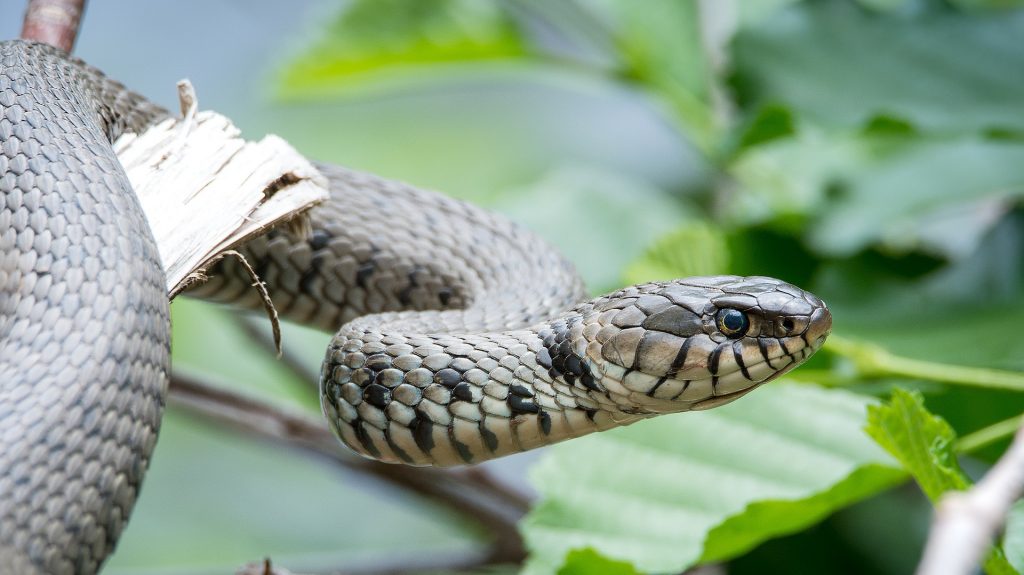
The Grass snake is the largest of the UK’s native snakes. It is also the most common and widespread, although is more sparse the further north you go.
Identification:
- Easy to differentiate from Adders as they do not have the dark zigzag down their backs.
- Generally grey-green coloured (colours vary from bright green to black) with black bars down their sides.
- Most have a yellow and black ‘collar’ around the neck.
- Average female length: 75 to 80 cm. Average male length: 65 cm
Habitat:
As grass snakes feed on amphibians and fish, they live close to water, including garden ponds. Compost heaps in gardens may be used when ready to lay eggs.
Distribution:

Grass snakes are found throughout England and Wales. It is often said that they are not found in Scotland but there have been recent reports of them in southern and eastern Scotland.
Activity:
Active from April to October, grass snakes aren’t venomous and they are very shy. They tend to play dead if they’re cornered! If caught, grass snakes hiss and release a foul-smelling substance from their anal gland. Although they may strike with the head, they do not bite and are harmless to humans
Grass snakes hibernate from October to March/April when temperatures are too low for them. To do this, they find frost-free places such as deep leaf litter or rock piles.
Smooth Snake (Coronella austriaca)

Smooth snakes are extremely rare, found only in a small part of southern England. They are browner than grass snakes and the black markings are on their back rather than their sides. They look a bit like Adders but without the distinctive zigzagging along their backs.
Smooth snakes are strictly protected by European law and reintroduction programmes are trying to save this species from extinction in Britain.
Identification:
- The smooth snake’s scales are flat and smooth. This is unlike those of the grass snake and adder which have a ridge (or ‘keel’) down the middle.
- Round pupils.
- Smaller and more slender than other snakes, usually only growing to 60-70cm in length.
- Generally grey or a dull brown colour with black markings arranged in bars or two rows of dots down the back.
- Smooth snakes nearly always possess a heart-shaped “crown” marking, which covers the top of the head.
- An eye stripe is usually present, extending from the eyes along the side of the head.
Habitat:
The Smooth snake is found naturally only on heathlands in Dorset, Hampshire and a very few sites in Surrey. The smooth snake is dependent on well managed heathland, where it is mainly found in mature vegetation that provides good cover. On these sites it can use a range of habitats, from dry slopes to humid and wet heath areas.
Distribution:
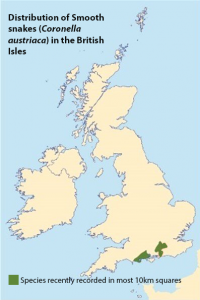
Very rare. Confined to sandy heaths in Dorset, Hampshire and Surrey. Reintroduced populations exist in West Sussex and Devon.
Activity:
Active April to October. Smooth snakes usually emerge from hibernation in April/early May. They are constrictors and mainly feed on common lizards, slow-worms and small mammals such as shrews and nestling rodents. Live young, which look very similar to adults, are born in September. Smooth snakes are long-lived and females tend not to breed every year. The smooth snake basks in the sun entwined amongst the stems of heather plants, where it is well camouflaged.
Slow-worm (Anguis fragilis)

Slow-worms are thought to be the most common reptile in Europe. However, they are not seen very often as they do not usually bask in the open. They prefer to hide under rocks and logs. Emerging at dusk and after rain, they feed on slugs, worms and other slow moving prey. The scientific name, Anguis fragilis, translates as ‘fragile snake’ and refers to the ability of this lizard to shed its tail when seized. Slow-worms are not snakes. They are legless lizards and so are often mistaken for snakes.
Identification:
- Much smaller than a snake. Generally 40 – 50 cm long.
- Smooth, shiny appearance.
- Check to see if it blinks. Lizards have eyelids but snakes don’t.
- Males are grey or brown, sometimes with bright blue spots.
- Females are golden brown, often with a thick dark line down their back.
- Juvenile slow-worms are very thin and are initially around 4cm long.
- Juveniles have black bellies and gold or silver dorsal sides. They sometimes have a stripe running along the length of the body.
Habitat:
Slow-worms are found in a wide range of habitats such as heathland, tussocky grassland, woodland edges. However they tend to hide under logs or compost heaps etc, rather than basking in the sun. They may be found in mature gardens, allotments and compost heaps. In such places food is plentiful and rotting plant material creates warm conditions.
Distribution:

Slow-worms are found throughout Great Britain, except for most Scottish islands. They are not found in Ireland or most of the Channel Islands.
Activity:
Active March to November. Slow-worms feed on slow-moving prey, especially small slugs. Female slow-worms incubate their eggs internally and ‘give birth’ in the late summer.
Protection
All UK reptiles are protected by national law, which makes it illegal to deliberately kill, injure or sell individuals of any species. They are fantastic to spot, but please observe them from a distance and do not disturb unnecessarily.
For further information visit www.wildlifetrusts.org or www.arc-trust.org
You may also be interested in:
Snakebite Season by Johan Marais, African Snakebite Institute

Grass snakes can get to about 5 feet long and about 3 inches diameter, I have a picture of a Male that is approximately that size that I actually took in Sandhurst Berkshire a few years ago.
That must have been quite a sight. If you still have the photograph, we’d be more than happy to add it into the article 🙂