
Joint approach needed to tackle littering problems in highlands
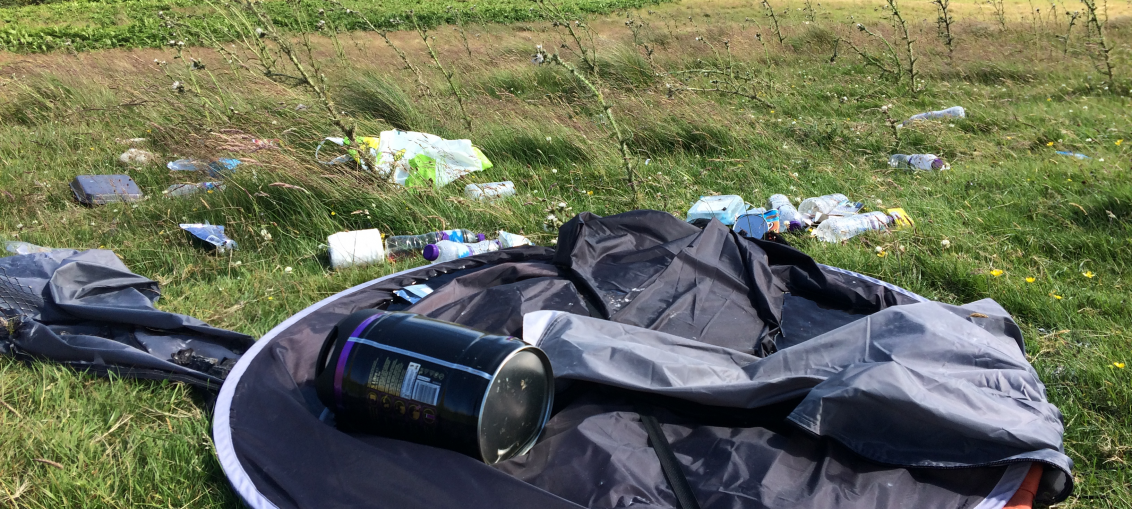
Responsible mountaineers have called for action to be taken against the growth of ‘dirty camping’. This is when irresponsible campers leave rubbish, fire damage and even whole campsites in their wake.
Mountaineering Scotland is calling for a multi-agency approach to work with communities on local management solutions. It also demands a public information campaign to educate people about their responsibilities as well as their rights.
Dirty camping in rural hotspots
Summer saw the problem of dirty camping become increasingly common in rural hotspots across the country. Mountaineering Scotland’s Access & Conservation Officer Davie Black said: “Antisocial camping can and should be dealt with.”
“We call for all those who are concerned about this to come up with local management plans that identify the problem and its causes”. Furthermore, “the resources needed to tackle it” need to be identified.

“There is already legislation covering anti-social activity. What we need is coordination of resources to enforce it.”
Human waste!
Roadside camping is where the problem is worst. People pitch camp close to where their car is parked. Many leave behind plastic and glass, burnt ground and even camping kit and human waste.
It’s a problem that doesn’t just anger local people who live and work in affected areas. Other visitors to the areas, including responsible hill-goers and campers are also upset.
Davie Black said: “It is easy to associate all informal camping with rubbish and pollution, but the truth is different.” He states that walkers and climbers wild-camping in the hills tend to “leave little trace of where they have been.” Furthermore, roadside campers who leave no trace are also ‘invisible’. “But the trail of dirty roadside camping is only too visible and is what gives all campers a bad reputation.”

Wild camping and roadside camping
Wild camping is usually done well away from roads and buildings. It tends to be lightweight and done in small numbers. Usually it’s only for two or three nights in any one place. Roadside camping is not usually considered wild camping, although it does take place and is lawful if done responsibly.
Stuart Younie, Chief Executive Officer of Mountaineering Scotland, said: “We have seen a lot of camping this summer.” Furthermore, “it’s great to see people getting out to enjoy Scotland’s stunning scenery and the outdoor lifestyle”. However, “the downside has been the number of campers ruining beauty spots for other visitors and those who live there.”
“We have enlightened legislation that allows people the freedom to camp.” It also “provides for tackling anti-social behaviour where it is required.” However, it is acknowledged that “the police and local authorities don’t have the resources to monitor every hill and glen.”
Promoting responsible behaviour
“Mountaineering Scotland does what it can to promote responsible behaviour. We think greater emphasis should be placed on government agencies, councils and national organisations working together with communities to develop local management solutions. We know where the pressure spots are.”
It is almost 15 years since the publication of the Scottish Outdoor Access Code. Therefore it is “time to consider a public information campaign to remind people about their rights and responsibilities.” This includes “the impact that irresponsible camping has on local people and the environment.”
Mountaineering Scotland provides advice on minimising your impact when in the mountains:
www.mountaineering.scot/conservation/campaigns/minimal-impact
Through its Tak It Hame campaign Mountaineering Scotland also urges everyone who loves walking and climbing in the hills to avoid littering and to pick up any litter they find: www.mountaineering.scot/conservation/campaigns/tak-it-hame
About Mountaineering Scotland:
- The only recognised representative organisation for hill walkers, climbers and ski-tourers who live in Scotland or who enjoy Scotland’s mountains.
- Provides training and information to mountain users to promote safety, self-reliance and the enjoyment of our mountain environment.
- A membership organisation with over 14,000 members representing hill walkers, climbers and mountaineers. Funded through a combination of membership subscriptions, non-governmental grants and investment from sportscotland. Supports public initiatives and services in mountain safety, mountain training and the development and promotion of mountaineering activities.
- Acts for 75,000 members of the BMC or British Mountaineering Council on matters related to Landscape and Access in Scotland.
- The Scottish Mountaineering Trust and the BMC financially support Mountaineering Scotland landscape and access work.
- Launched the ClimbScotland initiative to encourage young people to participate in climbing and support their progression. It offers a dedicated website and a development team. This will introduce young people to climbing at schools, climbing walls and via youth organisations with a range of activities and events. Develops kids clubs and provides specialist support to parents, volunteers and teachers.
- The national governing body for sports climbing. It offers pathways to climbing coaching, organises and promotes a range of regional and national climbing competitions, and manages the Scottish climbing and bouldering teams. It contributes to the management of the GB teams with the ultimate aim of seeing a Scottish athlete achieve a podium position in the Olympic Games.
- The MCofS is a not for profit company limited by guarantee and incorporated in Scotland. Company number SC322717.
- Mountaineering Scotland, The Granary, West Mill Street, Perth PH1 5QP

For further information, visit https://www.mountaineering.scot

One thought on “Mountaineers call time on dirty camping”