
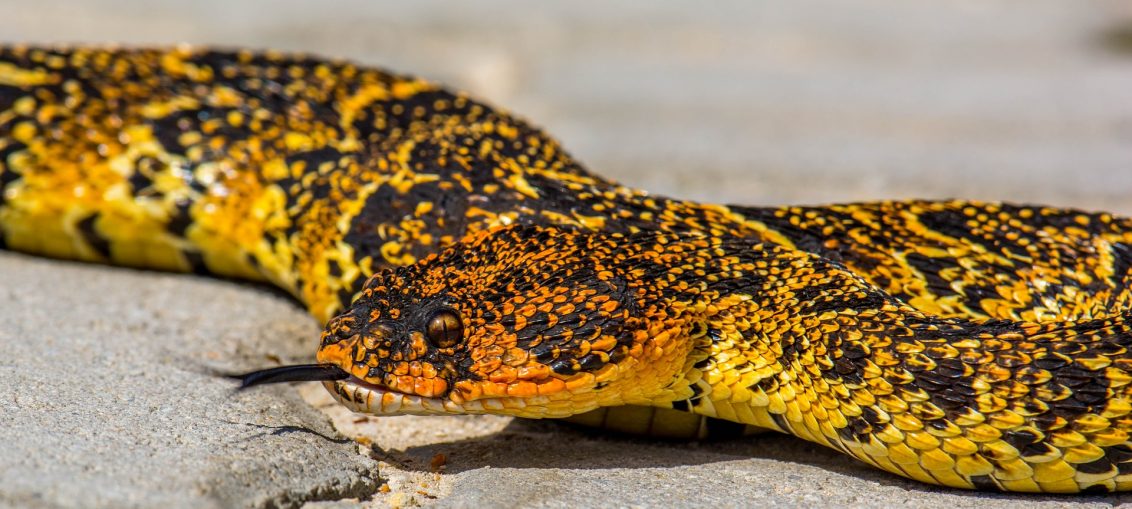
Summer is snakebite season and especially when the summer rains fall. However, recent press reports that the hot weather brings out more snakes are not quite true. Snakes keep a low profile when it is really hot and dry. We have found this to be the case during various reptile surveys. Dehydration is a real danger for any snake. Consequently, in very hot and dry conditions they remain dormant underground or in hollow tree trunks. But when the rains come they are very active. We often drive quiet roads at night after good rains in search of snakes. In such conditions it is not unusual to find dozens of snakes crossing the roads.
Snake bites and statistics
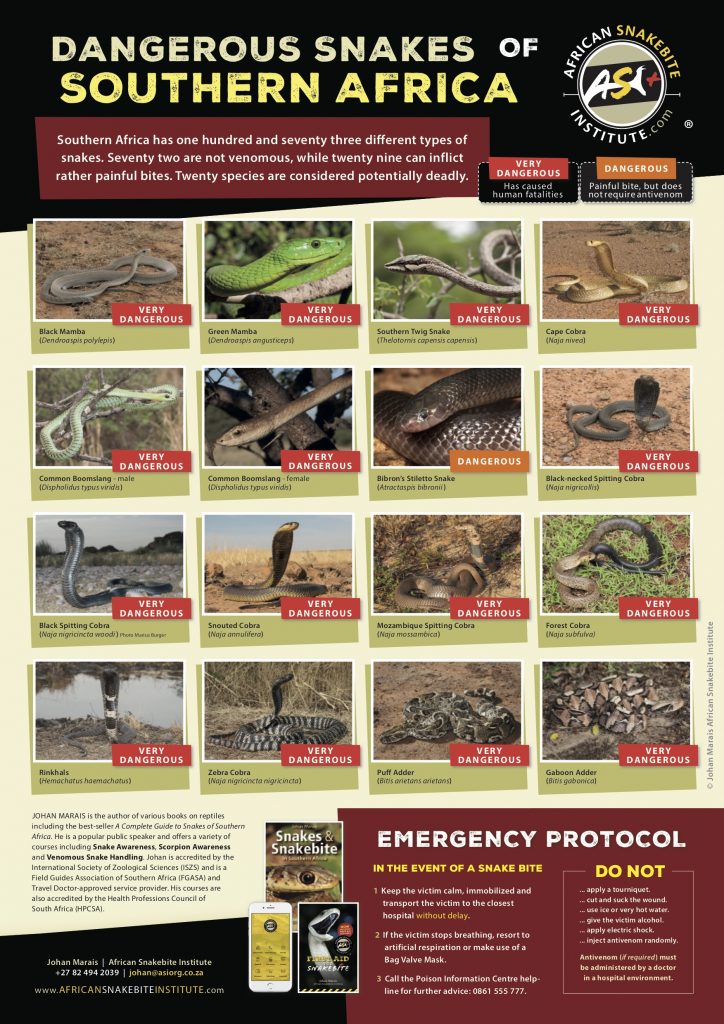
If one looks at the statistics, the majority of serious snakebites occur between January and April, largely in the evening. Around 84% of all bites are on the legs, below the knee, followed by bites to the hands. Well over 90% of all bites are from the Mozambique Spitting Cobra, Puff Adder, Night Adder and the Stiletto snake.

These bites are often extremely painful and are accompanied by swelling, blisters and subsequent tissue damage. Fatalities are rare but morbidity is something to consider. Some patients spend months in hospitals and require multiple operations to repair tissue damage.
Nothing repels snakes
Encountering snakes in one’s garden is a common occurrence, even in suburbs surrounding cities. The less developed the area is, the bigger the likelihood of encountering the odd snake. Despite popular belief, there is nothing that repels snakes. This includes Jeyes Fluid, Condies Crystals, chlorine, magnesium, naphthalene and old oil. The same goes for commercially-available snake repellents and all plants including Geraniums and wild garlic. Snakes hunt for food and may end up in your garden. Keep your garden clean of building rubble and compost heaps as well as piles of rocks. Also bear in mind that water features will lure frogs – and many snakes feed on frogs.
Encountering a snake could be traumatic. Do not try to kill or catch any snake. Many people end up in hospital every year because they tried to kill or rescue a snake. Keep a safe distance of 5 m or more and call a snake remover. There is a comprehensive list of snake removers on www.africansnakebiteinstitute.com. Make sure you keep an eye on the snake – they are masters at escaping and disappear in no time.
Various businesses, such as game lodges, mines, wind and solar farms, as well as numerous others, often encounter snakes on site.
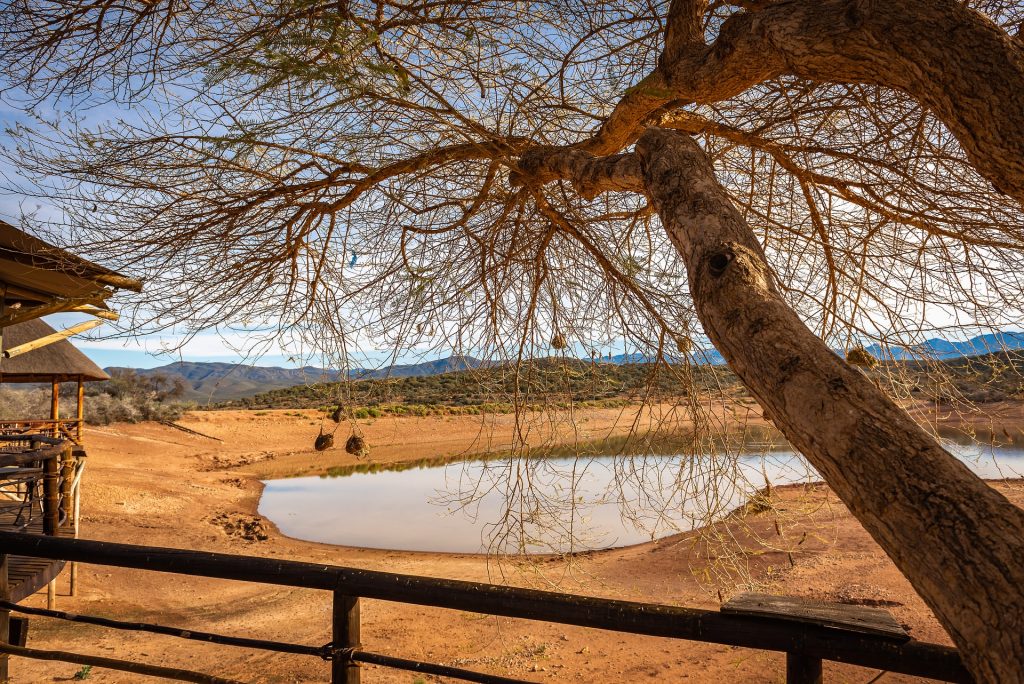
It is vitally important that such organisations have a good and workable emergency procedure in place to deal with such situations. This is well defined in the The Occupational Health and Safety Act . Failing to adhere to these requirements could result in very expensive litigation. In this regard we offer a variety of snake awareness, venomous snake handling and first aid for snakebite training courses. These courses are FGASA-endorsed and accredited by the Health Professions Council of South Africa.
What to do if a snake is spotted:
1). Should you spot a snake, you must not try to kill or capture it. Only if you’re trained, certified and in possession of the correct equipment should you do this.
2). Maintain a safe distance of 5m or more. Watch the snake carefully. Notify management to either:
- summon a qualified snake catcher within the company, or
- contact an outsider who can safely catch and remove the snake.
3). Once captured, the snake must be removed immediately off site. It should be released 5 – 10 km away in suitable habitat and away from people. In most provinces a catch and release permit is required.
Antivenom:
Antivenom is not a first aid treatment and should never be used by lay people. Because of possible complications, and even anaphylaxis, antivenom should only be administered in a hospital environment. This must be by a medical doctor and only if required. Over 85% of snakebite victims that are hospitalised do not need, nor receive, antivenom.
Establishing which hospitals stock antivenom is not easy. Even those that usually have it often use it without replenishing the stock immediately. If this is of concern to you, visit your local hospital and discuss snakebite treatment and antivenom with them.
Many of our corporate clients throughout Africa stock polyvalent antivenom. In the event of a snakebite they will send their stock of antivenom with the patient to the hospital. Should you wish to do so, you need to stock at least 12 – 15 vials of polyvalent antivenom. This currently costs R1,436 (approx £75) per vial. It has to be refrigerated (not frozen) but expires after three years.
Pets and snakebites:
In the case of a serious snakebite on your pet, get your pet to the nearest vet urgently. This is especially likely with dogs. Dogs attack and try to kill snakes. In serious cases your pet will require antivenom. Such a treatment may cost anything from R5,000 – R20,000 (approx £260 – £1,045). Do not waste time with Allergex tablets, charcoal, milk or any of the other popular first aid treatments. These are not going to do anything to save the life of your pet.
Snake Removals List.
The African Snakebite Institute has a comprehensive list of snake removers around the country. For anyone who has completed an ASI course in the past and would like to be added to the list: drop Sake an email – info@asiorg.co.za This list will be updated periodically.
About the author:

Johan Marais is one of Africa’s leading herpetologists, with over 40 years experience. He is the most prominent author of snake books in Africa and has written the bestsellers A Complete Guide to the Snakes of Southern Africa, Snakes and Snakebite and First Aid for Snakebite. Johan is the snake expert for the Tygerberg Poison Centre and the Red Cross Poison Centre.
He presents courses for the African Snakebite Institute. This is the leading training provider of Snake Awareness, First Aid for Snakebite and Venomous Snake handling in Africa.
African Snakebite Institute | +27 82 494 2039
E-mail johan@asiorg.co.za
Find out more at www.africansnakebiteinstitute.com
