

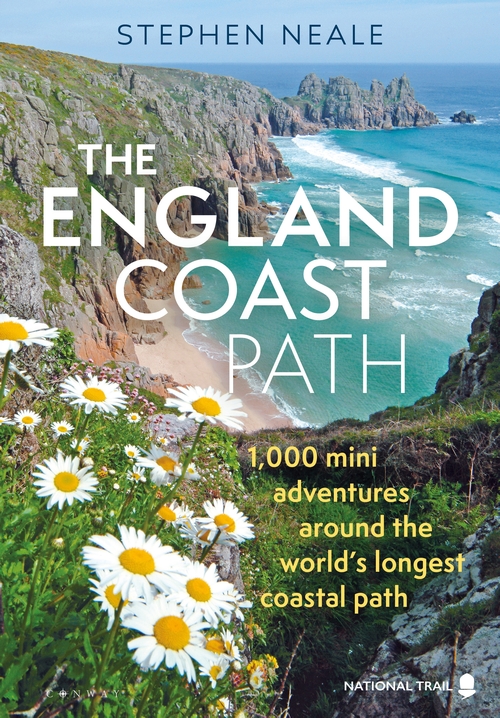
The England Coast Path by Stephen Neale
England has, arguably, the most spectacular variety of coastline in the world. The England Coast Path has therefore got to be an incredibly impressive route. It includes rugged rockfaces to sunken sands, secret caves to prehistoric beaches, uninhabited islands to ancient woodland. So, what better than a guide book providing details of 1,000 different things to see and do along the route?
This is not a book about wild camping or bushcraft. It’s not even a guide to completing a long distance footpath. It is about highlighting some pleasant and interesting places to visit. Having said that, if you are interested in wild camping along this route, a section is included in Neale’s book, Wild Camping.
Part 1: The Magic Path
Neale sets the scene by introducing the reader to ‘the magic path’ with an interesting fact about Formby Beach. Here you can see 8,000 year old human footprints which appear at low tide. Such features get the explorer thinking about the people who left those prints. It is this connection which makes getting out onto the coastal path much more than a saunter in nice countryside.
The book celebrates the outcome of a group of people who came together to gain access for all to this amazing shoreline. It provides details of ‘coffee shops to caves. B&Bs to beaches and hill forts to hotels’. In other words, there’s plenty for the day tripper, with or without children, and those away for a few nights.
Part 1 is mostly about the ‘people of the path’. These are the visionaries who championed the route and making it available to all. They include politicians, conservationists, landowners and volunteers with suitable skills and knowledge. It’s interesting background reading but not necessarily what someone who buys the book is focussed on. Fortunately it’s only a very small part of the book.
Also included in Part 1 is a section entitled ’18 Wonders of the England Coast Path’. Neale provides snapshot descriptions of some of what he considers to be the best places for specific features or pursuits. These include hidden beaches, canoes and wild camping, foraging, fossil hunting as well as various other natural attractions. For each feature or pursuit, a selection of locations for the South East, South West, North East and North West are given.
Part 2: The Coast Path

The bulk of the book is covered in Part 2 and begins by stating the objectives of the book and how to use it. It gives suggestions for making use of the different senses through different types of activity. Listen to crows over castle ruins, taste foraged fruits and leaves, smell a coastal pine forest. There is a key provided for symbols used through the book to help identify themes such as ‘Ancient and sacred’, ‘Woodland’ and ‘Accommodation’.
‘Wild things to do before you die’
At this point the coast path is broken down into areas, mostly by county. Both Devon and Cornwall have two sections, north and south, perhaps understandable as they do have northern and southern coastlines. Yet, Northumberland, despite having one of the most dramatic and coastlines and the most glorious sandy beaches doesn’t have its own section. It even features in 13 of the ’18 Wonders’ previously mentioned, and more than once in some cases. And that’s not including the likes of Noses Point which is actually in County Durham! Instead it is grouped with Tyne and Wear and County Durham in a section called Northumberland to Hartlepool.
Anyway, to get to the point, each area begins with a list of ‘wild things to do before you die’. For example, suggestions for Dorset include ‘snorkel the shallows of Kimmeridge Bay’ and ‘taste local scallops direct from Brixham Fish Market’. In Cumbria we are recommended to ‘dance round a stone circle on Birkrigg Common’ and ‘wild camp the River Duddon’. Each area has plenty of such suggestions and, possibly, things you wouldn’t have considered but would like to.
Things to do and see
Thereafter, it really is a guide about things to do and see. As previously mentioned, these are grouped into different categories and represented by symbols:
- Beach or coast
- Woodland
- Mother nature
- Ancient and sacred
- Good for dark skies
- Accommodation
- Restaurant or cafe
These all include a brief description and either an explanation of how to find the place or an address. Not every entry includes a photograph but the guide is dotted with some very attractive images throughout. A puffin at Flamborough Head, Hickling Broad boat houses, Holy Island castle, Weston shore. The list goes on. A few examples are given below:
Beach or coast
Hilbre Island in Cheshire & Liverpool, for instance, is described as a location to ‘wallow in the shallows at low tide’. Sea lions and seals can be seen here too. If kayaking, we are warned to be careful of powerful tidal creeks. Other examples include Seaford Beach in East Susses, Lansallow Cove in South Cornwall and Ribble Estuary in Lancashire.
Woodland
Syon Park & All Saints Isleworth on the Thames North Bank is typical of a pleasant location to enjoy woodland. The park here is described as ‘stunning’ and there is a wonderful church. Other nice examples include The Bench in Essex and High Cape in Norfolk. Leigh Woods in Gloucester & North Somerset and Firestone Copse on the Isle of Wight.

Mother nature
Again, there are some lovely examples. The only grey seal colony in Cumbria and many species of birds can be seen at South Walney, Barrow-in-Furness Harbour. There’s a spectacular pine-ringed lagoon at Brownsea Island, Poole Harbour where there’s plenty of wildlife.
Ancient and sacred
Sutton Hoo in Suffolk, with lots of burial mounds, is one of England’s most important archaeological sites. It’s just one of many ‘ancient and sacred’ locations mentioned in the book. Other wonderful examples include Giants Grave at Millom, the Seafarers Memorial Stone at Portishead and Fort James in Hampshire.
Good for dark skies
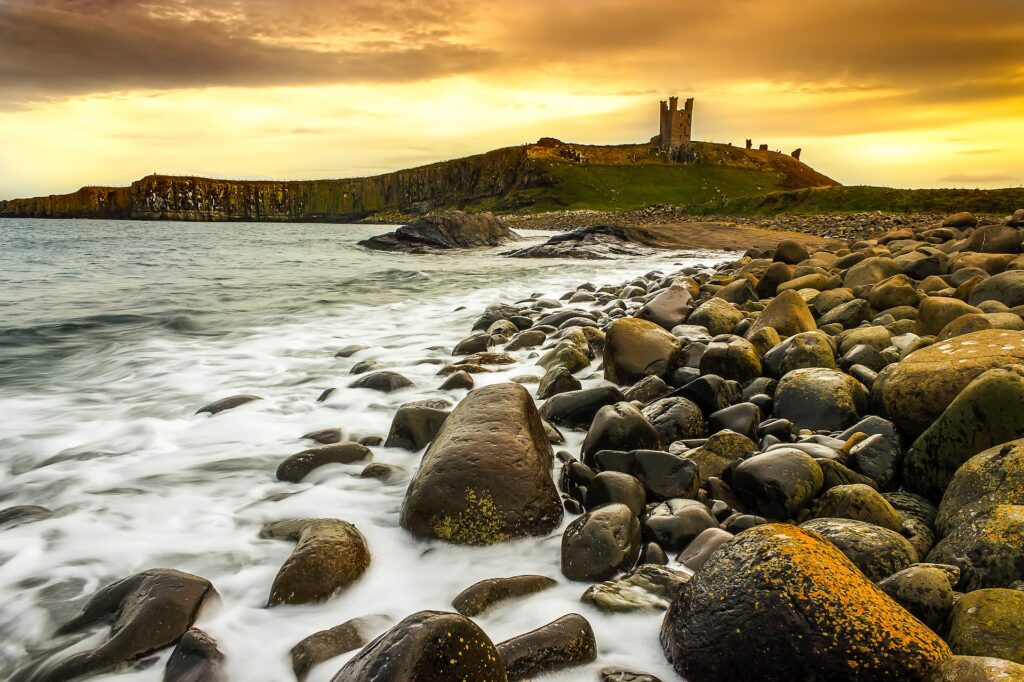
As well as being great places to visit in daylight, some locations are wonderful for their dark skies. Dunstanburgh Castle, Embleton is one such place where the silhouetted ruin can stand magnificently against a wonderful starlit backdrop. Likewise, Daws Castle in South Somerset is full of history. Here the idea of potential Viking invasion can be imagined on a still, dark night.
Accommodation
If you are planning on spending more than a day on the path, accommodation will be important. Recommendations for wild camping spots are occasionally provided but some of us require something more luxurious. This section covers hotels, holiday cottages, B&Bs, lodges and camp sites.
Restaurant or cafe
It’s always nice to be able to pop in somewhere for a cuppa and a bite to eat. I’m not sure if the author has been to all of the establishments mentioned as there are quite a few. Whether it’s a cafe, tearoom, restaurant or pub, there are sufficient to choose from.
In conclusion
All in all, ‘The England Coast Path’ is a nice little guide for those visiting a particular area for a day or more. The information is useful and tells us of a really good variety of places to go to make a very enjoyable visit to any part of the coastal path. It is useful for those wanting to visit one location or many locations. Furthermore it is suitable for those actually walking the trail, or a part of it, or driving to a nice little spot.
About Stephen Neale:

Stephen Neale is an award winning, Essex-based writer. He is best known for books on land access problems in the UK and Ireland. Furthermore, he was a volunteer surveyor on the England Coast Path. Works include Wild Camping (2015) Wild Camping II (2020) and the England Coast Path (2020). All three are published by Bloomsbury.
His collective fictional and non fictional works on the nature, landscape and histories of Essex received multiple awards, including the Outdoor Writers and Photographers Guild Prize for Digital Production of the Year (2016).
Neale is also a commercial drone operator and former lecturer in journalism at University of Essex and South Essex College. He has worked previously as a BBC journalist, and as a freelance writer for the Chinese state news agency Xinhua.
For more information, visit his website.
You may also be interested in:
Wild Camping by Stephen Neale (Book Review)
Scottish Bothy Walks by Geoff Allan (Book Review)
Islandeering: Adventures Around the Edge of Britain’s Islands by Lisa Drewe (Book Review)
